The best climate risk assessment and management tool for a U.S. business is the one whose resolution, hazard coverage, scenario depth, and financial outputs match the decisions you actually need to make – not the one with the longest feature list.
When evaluating tools, the criteria that separate genuine decision-grade platforms from generic dashboards are: asset-level resolution (down to the parcel, not the county), forward-looking multi-scenario modeling, resilience adjustment that accounts for adaptation, financial translation into value and cost terms, and transparent, auditable methodology. The right tool turns a sprawling “assess our climate risk” mandate into ranked, costed, defensible answers your investment committee, lenders, and regulators will accept.
The short version: climate risk tools are not interchangeable, and “best” depends on fit. This guide explains how the tools work, the types available, what to look for, how to test for accuracy, and how U.S. businesses choose the right platform.
What Are Climate Risk Assessment and Management Tools?
Climate risk assessment and management tools are software platforms that help organizations measure, understand, and act on the risks climate change poses to their assets, operations, and portfolios. They sit at the intersection of climate science, geospatial data, and financial analysis – translating complex hazard data into decisions a business can make.
It helps to separate the two functions in the name:
- Assessment is the diagnostic side: identifying and scoring climate risk across hazards, locations, scenarios, and time horizons. It answers “where am I exposed and how badly?”
- Management is the action side: prioritizing risks, planning adaptation, allocating capital, transferring risk, and reporting. It answers “what do I do about it?”
The strongest platforms support both – and increasingly add climate risk analytics that go beyond static assessment to predictive, financially translated insight. AlphaGeo’s Climate Risk & Resilience Index is an example of a tool built to bridge assessment and management: it scores risk at the asset level and translates it into the financial terms that drive management decisions.
How Does Climate Risk Analytics Work and What Data Is Used?
Climate risk analytics works by running a pipeline that converts raw climate and geospatial data into decision-ready intelligence. The process:
- Data ingestion. The platform pulls hazard projections from climate models, plus contextual data on infrastructure, demographics, economics, and existing adaptation.
- Localization. That data is resolved to specific asset coordinates rather than regional averages — the finer the resolution, the more accurate the analytics.
- Risk scoring. Hazard exposure is scored across multiple emissions scenarios and time horizons, then weighted against vulnerability and adaptation capacity to produce a resilience-adjusted score.
- Financial translation. The risk is converted into business terms – expected loss, operating-cost and CapEx impacts, valuation effects.
- Reporting and integration. Results are delivered as scores, scenario comparisons, reports, and API feeds into existing systems.
The data inputs span several categories: climate and weather data (temperature, precipitation, sea level, storm projections), geospatial data (elevation, land use, asset locations), hazard-specific models (flood, fire, heat), adaptation data (defenses, infrastructure, resilience), and financial/economic data (asset values, costs, macro indicators). The breadth and quality of these inputs largely determine how good the analytics can be – AlphaGeo, for instance, combines proprietary climate, adaptation, and financial datasets to feed its climate resilience analytics.
Types of Climate Risk Tools (Assessment vs Management vs Analytics)
Not all climate risk tools do the same job. Understanding the categories prevents buying the wrong thing:
- Assessment tools focus on diagnosing risk – scoring hazard exposure across assets, scenarios, and horizons. Their output is a risk picture. Best when your primary need is to understand and quantify exposure (for example, for due diligence or disclosure).
- Management tools focus on acting on risk – prioritization, adaptation planning, workflow, and reporting. Their output is a plan or process. Best when you’ve identified risks and need to manage them across an organization.
- Analytics platforms focus on insight and prediction – combining assessment with financial translation, scenario modeling, and forecasting. Their output is decision intelligence. Best when you need risk connected to financial and strategic decisions.
In practice the categories blur, and the most capable platforms span all three: they assess at the asset level, deliver analytics that translate risk into financial terms, and support management through prioritization, planning, and reporting. The key when evaluating is to be clear about which function is your priority – and to confirm a tool genuinely delivers it rather than just claiming the label. Climate risk analytics like AlphaGeo’s climate resilience index is designed for assessment while feeding directly into management workflows.
What Should You Look for in Climate Risk Management Tools?

When evaluating climate risk management tools, prioritize these capabilities:
- Asset-level resolution. Scoring at the parcel or site level (ideally tens of meters or finer), not regional averages. This is the foundation everything else rests on.
- Comprehensive hazard coverage. All the perils material to your assets – flood (inland and coastal), heat, wildfire, hurricane, drought, and more – not just one or two.
- Resilience adjustment. Both a hazard baseline and an adaptation-adjusted score, so risk reflects real-world impact rather than worst-case hazard.
- Multi-scenario, multi-horizon modeling. Multiple emissions pathways and time horizons spanning near-term to end-of-century.
- Financial translation. Risk expressed as expected loss, operating cost, CapEx, and valuation impact – the language of management decisions and disclosure.
- Disclosure alignment. Outputs structured for frameworks like IFRS S2 and applicable state laws.
- Transparent methodology. Documented, auditable scoring that survives committee, lender, and regulator scrutiny.
- Integration and workflow fit. API access, exports, and portfolio tools that match how your organization operates.
A useful framing: a management tool should help you decide and act, not just see. If a tool stops at visualization without resilience adjustment, financial translation, and workflow support, it’s a dashboard, not a management platform.
How Do You Evaluate Climate Risk Assessment Tools for Accuracy and Reliability?
Accuracy is the most challenging to assess but the most important. No tool predicts the future perfectly, so “accuracy” really means rigor, resolution, and transparency. To evaluate it:
- Test on assets you know. Feed the tool a handful of locations you understand deeply and judge whether the scores — and crucially, the explanations behind them — match reality. The reasoning reveals quality the headline number hides.
- Probe the data resolution. Finer resolution (down to tens of meters or less) produces more accurate asset-level scores than coarse regional data. Ask exactly how granular the scoring is – but also how that granularity is achieved. Downscaling methodologies matter as much, or perhaps even more, than headline resolution numbers.
- Check for resilience adjustment. A tool that scores raw hazard without accounting for adaptation will systematically misjudge real risk. Confirm that the tools includes both hazard and resilience-adjusted impact.
- Examine the scenarios. Reliable tools model a range of futures (multiple emissions pathways and horizons) rather than a single forecast. A single-scenario tool overstates its own certainty.
- Demand methodological transparency. Documented, explainable methodology is a strongsignal of reliability. Black-box scores can’t be validated or defended — a red flag for both accuracy and compliance.
- Verify the data sources. Credible, science-based, and current inputs matter; confirm sources are maintained and up to date.
The paradox of accuracy is that the most reliable tools are often the ones most honest about uncertainty – modeling ranges, showing their method, and adjusting for adaptation rather than presenting a single confident number.
Key Data Inputs Used in US Climate Risk Analytics (e.g. weather, geospatial, financial)
The quality of climate risk analytics is bounded by the quality of its inputs. The key data categories for U.S. analytics include:
- Climate and weather data. Forward-looking projections of temperature, precipitation, sea level, and storm activity from climate models, plus historical observational records from sources like NOAA.
- Geospatial data. Elevation, drainage, land use, soil, and precise asset locations – the spatial backbone that lets risk be resolved to a parcel.
- Hazard models. Peril-specific models that translate climate variables into flood depth, fire probability, heat exposure, and surge at a given location.
- Adaptation data. Information on existing defenses – flood barriers, drainage, building standards – and broader societal and fiscal resilience, used to convert raw hazard into real-world risk.
- Financial and economic data. Asset values, replacement and operating costs, insurance data, and macroeconomic indicators that enable translation of risk into financial terms.
The differentiator among platforms is rarely any single dataset – it’s the fusion: how well a platform integrates climate, geospatial, adaptation, and financial data into a coherent, asset-level score. AlphaGeo’s breadth here – proprietary datasets spanning these categories, including its Global Adaptation Layer of on-the-ground adaptation data – is what underpins the resolution and resilience adjustment of its Climate Risk & Resilience Index.
Comparing Climate Risk Tools: Key Features and Capabilities
When comparing tools side by side, evaluate them across a consistent set of capabilities rather than marketing claims:
| Capability | Generic / basic tool | Decision-grade platform |
| Resolution | Regional (county/ZIP) | Asset-level (~100m) |
| Hazard coverage | One or two perils | Full multi-peril set |
| Time view | Historical / single scenario | Multiple scenarios and horizons |
| Adaptation | Raw hazard only | Resilience-adjusted scoring |
| Output | Maps and visuals | Financially translated, decision-ready |
| Disclosure | Limited | IFRS S2 / framework-aligned |
| Methodology | Opaque | Transparent and auditable |
| Integration | Standalone | API, exports, portfolio tools |
The pattern is consistent: basic tools describe, decision-grade platforms diagnose and translate. Any decision that allocates capital or feeds disclosure demandsdecision-grade outputs.
The comparison that matters most for U.S. buyers is whether a tool deliver asset-level assessments, adjust for adaptation, and translate risk into material financial terms – the three capabilities most often missing from generic offerings.
Common Limitations of Climate Risk Tools
Even strong tools have limitations, and understanding them sets realistic expectations:
- Uncertainty is inherent. Climate projections involve genuine uncertainty; no tool predicts the future precisely. This is a reason to model ranges, not a flaw to be eliminated.
- Data gaps. Coverage and resolution vary by geography and hazard; some regions and perils are better modeled than others.
- Resolution limits. Even asset-level tools have a resolution floor, and very localized features (a specific building’s drainage) may not be fully captured.
- Adaptation is hard to model. Quantifying existing and future defenses is complex.
- Black-box opacity. Some tools don’t disclose their methodology, making validation and defense difficult.
- Over-precision. A single confident score can imply more certainty than the science supports; honest tools communicate ranges and assumptions.
The right response to these limitations isn’t to avoid climate risk tools, but to choose those that manage climate risk’s inherent limitations consciously: modeling uncertainty transparently, adjusting for adaptation rigorously, and being transparent about what their tools can and cannot achieve A tool’s candor about its limits is itself a quality signal.
How US Businesses Choose the Right Climate Risk Platform
Choosing the right platform comes down to matching capability to need, then validating rigorously. A practical process:
- Define your decisions. Be specific about what you need the tool to support — site selection, portfolio management, disclosure, due diligence – because that determines which capabilities matter most.
- Set non-negotiables. For nearly every use case, that means asset-level resolution, resilience adjustment, multi-scenario modeling, financial translation, and transparent methodology.
- Shortlist on fit. Screen tools for the hazard coverage, geographies, and asset classes relevant to you.
- Test on real assets. Hand each finalist locations you know well and judge the scores and the explanations. This single step reveals more than any demo.
- Assess the partner. The best providers pair software with advisory expertise; evaluate whether the team can help you interpret and act, not just supply data.
- Confirm integration and support. API, exports, reporting alignment, and ongoing data updates.
One mistake to avoid is choosing a tool on feature count or brand rather than use case fit and validation. The right climate risk platform is the one that answers your decisions accurately and defensibly – which you can only confirm by testing it on assets you already understand.
You can test AlphaGeo’s platform on your own assets with a free trial here.
Conclusion
The best climate risk assessment and management tool is not a universal title – it’s a question of fit, validated by testing. Across U.S. use cases, the capabilities that separate decision-grade platforms from generic dashboards remain consistent: asset-level analytics, comprehensive hazard coverage, resilience adjustment, multi-scenario modeling, financial translation, and a transparent methodology.
By understanding the distinctions between assessment, management, and analytics, scrutinizing underlying data inputs, and testing finalists on assets you know well, your organization can select a platform to confidently allocate capital, satisfy regulators, and protect asset value.
To test a decision-grade, asset-level climate risk platform on your own assets, explore AlphaGeo’s Climate Resilience Suite, or book a demo.
Frequently Asked Questions
How does climate risk analytics work and what data is used?
Climate risk analytics works by ingesting climate and geospatial data, resolving it to specific asset locations, scoring hazard exposure across multiple scenarios and time horizons, weighting it against vulnerability and adaptation capacity to produce a resilience-adjusted score, and translating that score into financial terms. The data used spans several categories: climate and weather projections (temperature, precipitation, sea level, storms), geospatial data (elevation, land use, asset coordinates), hazard-specific models (flood, fire, heat), adaptation data (existing defenses and resilience), and financial data (asset values, costs, insurance). The quality of the analytics depends heavily on the breadth and resolution of these inputs and how well they’re fused – AlphaGeo’s analytics combine climate, adaptation, and financial data to produce asset-level, resilience-adjusted scores through its Climate Risk & Resilience Index.
What climate risk assessment platforms do infrastructure investors in the US recommend for portfolio analysis?
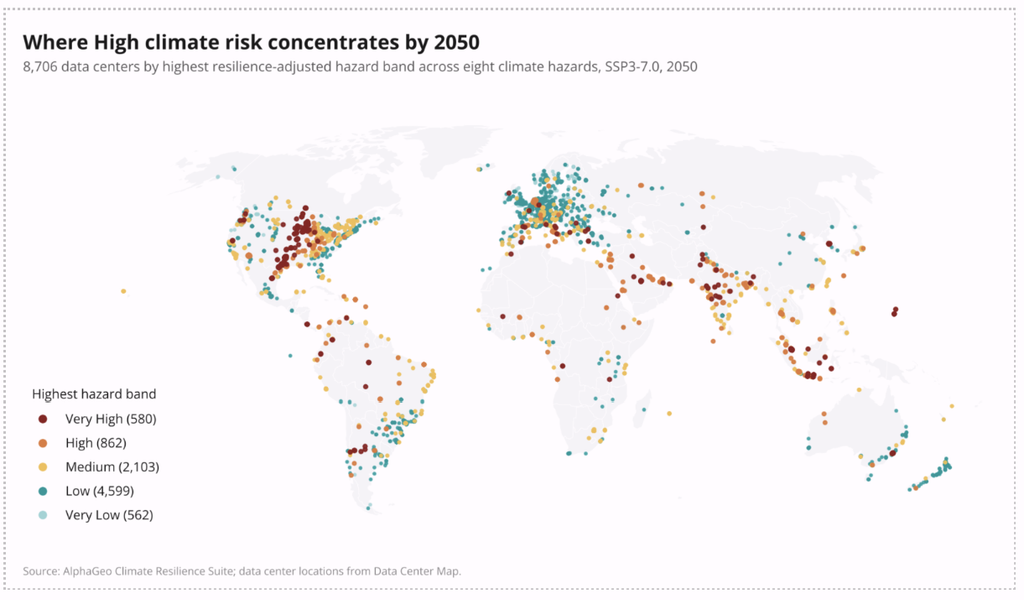
Infrastructure investors favor platforms that combine deep, asset-level physical-risk modeling with the long time horizons and financial analysis that infrastructure portfolios require – because these assets operate for decades and risk must be assessed out to 2050 and beyond. For portfolio analysis specifically, they prioritize the ability to score many assets consistently, roll exposure up to the portfolio level, model multiple scenarios, and translate risk into climate-adjusted discount rates and CapEx/OpEx impacts. AlphaGeo is built for this, with a Climate Resilience Suite that models climate impact across transport, energy, data centers, and other infrastructure, a Climate Risk & Resilience Index that scores across SSP scenarios and horizons to 2100, and infrastructure clients including EQT. As with any platform choice, the recommendation depends on fit – match peril coverage, horizons, and geographic depth to the specific portfolio and validate on assets already understood.
What are the top climate risk management tools used by asset managers in the United States?
Asset managers in the U.S. prioritize tools that can score large, diverse portfolios at scale, distinguish resilience-adjusted risk from raw hazard, translate exposure into valuation and reporting terms, and produce disclosure-aligned outputs for frameworks like IFRS S2. At portfolio scale, the job is consistent screening and ranking across an entire book, so portfolio-level scoring, API access, and transparent methodology become decisive. AlphaGeo serves this through its Climate Resilience Suite, built for institutional investors including asset managers, pension funds, and sovereign wealth funds, accessible via its SaaS platform AlphaGeo Explorer, API, or Snowflake. The “top” tool for any given manager depends on portfolio composition and reporting obligations — which is why testing on known holdings before committing is essential.
Which companies in the United States provide climate resilience index assessment services for commercial real estate portfolios?
A range of climate-intelligence providers offer resilience-index-style assessment for U.S. commercial real estate, but they differ sharply in resolution, adaptation modeling, and financial translation. A genuine climate resilience index (as opposed to a hazard map) should score risk at the parcel level, distinguish hazard-only from resilience-adjusted impact, model multiple scenarios and horizons, and translate results into value and cost terms for portfolio decisions and disclosure.
AlphaGeo’s Climate Resilience Suite provides exactly this through its Climate Risk & Resilience Index analytics, which scores nine hazards at resolution down to 5–10 meters with a triple-layer adaptation offset, and works with real estate clients such as Stoneweg US and Grubb Properties. Evaluate any provider by testing it on properties you know and weighing resolution, adaptation method, and transparency.
How do you measure and quantify climate resilience using data?
Climate resilience is measured by combining hazard exposure with adaptive capacity – quantifying not just the risk a location faces but the protection it has against that risk. In data terms, this means scoring physical hazard exposure at the asset level, then applying an adaptation adjustment that accounts for existing defenses (flood barriers, drainage, building standards) and broader societal and fiscal resilience, to produce a resilience-adjusted score distinct from the raw hazard score. The gap between hazard and resilience-adjusted risk effectively measures the adaptation in place. AlphaGeo quantifies this through a triple-layer adaptation offset – local adaptation capacity, societal resilience, and asset-level remediation – producing both a Physical Risk Score and a Resilience-Adjusted Risk Score so resilience can be measured, compared, and tracked over time.
What is the difference between climate risk assessment tools and climate risk management tools?
Assessment tools and management tools serve different stages of the same process. Climate risk assessment tools diagnose exposure – they identify and score the risks an organization faces across hazards, locations, scenarios, and horizons, answering “where am I exposed and how badly?” Climate risk management tools act on that diagnosis – they support prioritization, adaptation planning, capital allocation, risk transfer, and reporting, answering “what do I do about it?” Many capable platforms span both, adding analytics that translate risk into financial terms to connect assessment with management decisions. When choosing, be clear about whether your priority is understanding risk, acting on it, or both – and confirm the tool genuinely delivers that function.
Quick Links:
Climate Resilience Suite
Global Adaptation Layer
Alpha Finder