In an era defined by intensifying climate volatility, shifting structural demand, and geopolitical realignment, institutional asset owners face a historic challenge. For sovereign wealth funds, pension funds, and insurance companies managing “location-locked” real assets, traditional models of risk assessment are no longer sufficient. To protect and grow value across real estate, infrastructure, and land, a new grade of intelligence is required — one that moves beyond simple hazard maps to provide a holistic view of climate, market, and macro forces.
AlphaGeo is built for this complexity. Trusted by institutional investors managing over US$1 trillion in assets, our platform provides the transparency and precision necessary to future-proof global portfolios.
Physical risk is already reshaping returns. MSCI estimates potential average annual losses of $1.3 trillion across approximately 9,350 listed companies globally, with roughly 86% of that exposure tied to chronic hazards — extreme heat alone may erode some $600 billion annually. Uninsured natural catastrophe losses reached $181 billion in 2024, suggesting the insurance buffer institutional investors have historically relied on is no longer holding. Recent event-study analysis found that the most exposed firms underperformed by as much as 40 basis points by day 30, after controlling for market, sector and style factors.
Beyond Risk: Modeling Climate Resilience and Adaptation Alpha
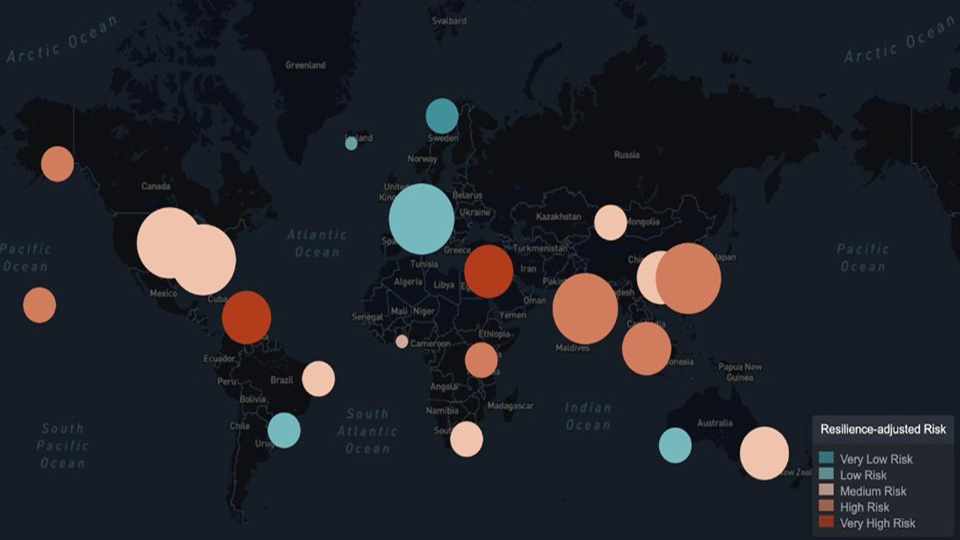
For years, the physical climate risk industry, including large vendors such as MSCI, has focused on hazard exposure — identifying where the fires, floods, and storms will hit. While essential, this “hazard-only” view is incomplete. AlphaGeo goes further by modeling Resilience-Adjusted Risk.
The most damaging climate risks are not always the most visible. Chronic hazards — extreme heat, water stress, and similar slow-onset stresses — account for roughly 86% of total modeled losses, far outweighing the storms and floods that dominate the headlines. Equally striking, in MSCI’s analysis of 18 asset-owner portfolios, potential business interruption losses ran 14 times larger than asset damage losses ($1.1 trillion versus $76 billion in estimated average annual losses). Focusing only on property damage may therefore significantly understate total physical risk exposure — a particularly acute concern for owners of real assets with multi-decade holding periods.
By accounting for local adaptation capacity and societal resilience, we provide a more accurate picture of an asset’s true vulnerability. This enables asset owners to not only mitigate downside loss but to identify “Adaptation Alpha” — the value created through proactive adaptation investments. Our platform translates these climate exposures into asset-specific financial metrics, allowing sustainability and investment teams to model ROI on resilience measures across multiple real asset classes.
Within the AlphaGeo framework, every real asset can be plotted on two axes: how exposed it is to physical hazards, and how prepared its location is to absorb them. Assets sitting in the high-exposure, low-preparedness quadrant become the natural priorities for engagement and, where action is not forthcoming, repositioning. This is where Adaptation Alpha is created. Unlike approaches that rely solely on corporate self-reporting, AlphaGeo grounds the resilience axis in granular local adaptation capacity, giving asset owners a view that company disclosures simply cannot provide.
Beyond defensive positioning, adaptation is increasingly framed as a thematic investment area in its own right, with structural growth drivers behind rising demand for climate-resilient infrastructure.
The opportunity spans four systems — natural and landscape resilience, food and water systems, the built environment and urban infrastructure, and social resilience — each addressable through capital and financing, insurance and risk transfer, physical solutions and enabling technologies, or advisory and operational support.
For real asset allocators, this opens parallel pathways: investing in adaptation solution providers, tilting portfolios toward more climate-resilient physical assets, and issuing adaptation- and resilience-specific financial products.
Navigating Market Dynamism and Macro Stability
Climate is not the only force reshaping the map. To make informed allocation decisions, asset owners must understand the structural demand and macro-stability of the markets where their capital resides.
AlphaGeo’s Market Dynamism signals allow investors to instantly screen the potential of new acquisitions — from residential and commercial to industrial sites — benchmarking each location against competing opportunities. Simultaneously, our Location Macro capabilities accelerate pre-due diligence by screening for fiscal, regulatory, and geopolitical risks. For long-term holders, this means the ability to monitor the risk profile of an existing portfolio in real-time, allowing for agile adaptation to shifting institutional or structural changes.
Why Asset Owners Choose AlphaGeo
The transition from “black box” data to defensible investment workflows is a core pillar of the AlphaGeo philosophy. Asset owners choose our platform for three primary reasons:
- Independent Oversight: We provide a portfolio-scale view that gives asset owners independent visibility across all external managers. With a consistent baseline for physical risk and macro fundamentals, you can validate disclosures and ensure manager alignment with your fund’s risk appetite. Among the most highly exposed companies in asset owner portfolios, only 30% currently disclose how they manage physical climate risk. Without an independent baseline, asset owners are effectively relying on incomplete information to make some of their most consequential allocation decisions.
- Cross-Functional Intelligence: AlphaGeo serves as a single source of truth. While sustainability teams use our analytics for TCFD or SFDR reporting, investment teams utilize the same data for site screening and underwriting. This unified approach breaks down silos and ensures that location-based decisions are backed by the same rigorous data.
- Transparency and Traceability: Every metric in the AlphaGeo ecosystem is explainable and built for the scrutiny of investment committees. There are no black boxes — only data-driven insights designed to be integrated into real-world decision-making.
Strategic Use Cases: From Allocation to Insurance Optimization
The application of AlphaGeo intelligence spans the entire lifecycle of an institutional portfolio, from top-down allocation to asset-level optimization:
- Strategic Asset Allocation: Use forward-looking location intelligence to inform geographic and sectoral allocation decisions, ensuring the long-term resilience of the total fund.
- External Manager Due Diligence and Oversight: Evaluate and monitor the risk management practices of asset managers using standardized metrics as objective benchmarks.
- Acquisitions Screening and Decision Support: Instantly screen locations for climate, macro, and market risks to support go/no-go decisions before committing to expensive due diligence.
- Due Diligence: Leverage integrated climate, environmental, and macro data for everything from commercial to technical and country-level diligence.
- Valuation and Underwriting: Integrate financial and operational metrics that translate location-based risks into cash flow modeling for more robust asset pricing.
- Physical Climate Risk Assessment: Stress-test full portfolios and single assets for physical climate risks, identifying critical adaptation gaps and financial impact.
- Enterprise Risk Management: Proactively identify interconnected location-based risks — from physical hazards to institutional changes — to limit downside losses and protect total asset value.
Building a Resilient Future
As the physical world changes, the data used to value it must evolve. AlphaGeo provides asset owners with the tools to navigate this transition with confidence. By combining climate resilience, market dynamism, and macro-stability into a single, defensible platform, we empower institutional investors to protect their legacy and lead the way in the next generation of resilient investing.