In September 2017, Hurricane Maria made landfall in Puerto Rico. Within hours, much of the island lost power. Pharmaceutical factories shut down. Production lines stopped. One of the world’s most important drug manufacturing hubs had gone offline.
The consequences reached far beyond the Caribbean. Puerto Rico produced roughly half of the small-volume IV saline used in the United States. As inventories dwindled, hospitals rationed supplies, elective procedures were postponed, and the FDA was forced to authorize emergency imports from Ireland and Australia.
The event exposed something few outside the industry had fully appreciated: America’s medicine cabinet depends on a surprisingly concentrated global manufacturing network.
Nearly a decade later, that concentration remains. But the risk is no longer limited to once-in-a-generation hurricanes. Our analysis suggests that heat — not hurricanes — will become the defining climate challenge for pharmaceutical manufacturing over the coming decades.
Using AlphaGeo’s Climate Resilience Suite, we analyzed 10,235 FDA-registered pharmaceutical facilities supplying the US market. The findings reveal a supply chain becoming steadily more exposed to physical climate risk, with more than 40% of facilities projected to fall into the high-risk category by mid-century under a high-emissions scenario.
For pharmaceutical manufacturers, investors, regulators, and healthcare systems, physical climate risk is no longer an environmental issue. It is becoming a supply-chain issue. A financial issue. And increasingly, a healthcare resilience issue.
Five things every pharmaceutical executive should know
1. Heat — not hurricanes — is becoming the industry’s biggest climate threat.
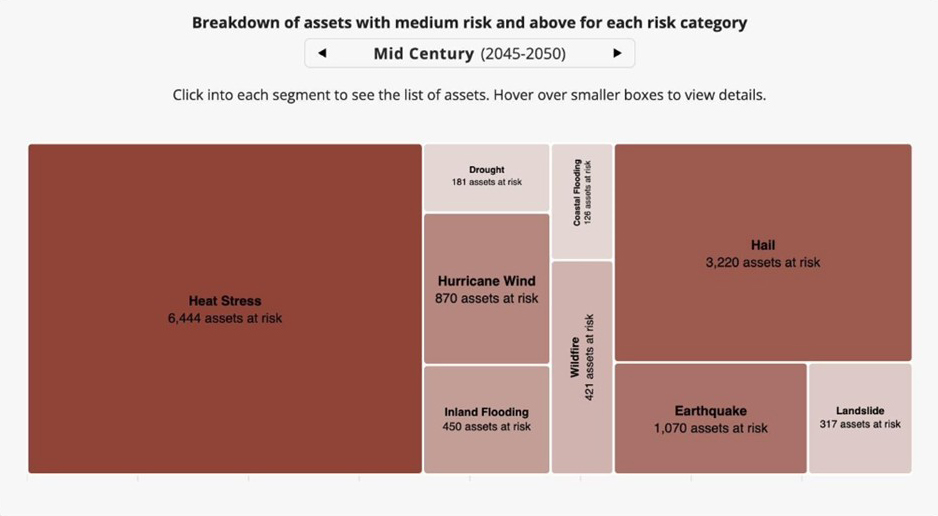
Extreme heat increasingly dominates every other physical hazard. By mid-century, approximately 6,444 registered facilities face elevated heat exposure, while hazards such as hurricanes, hail, and earthquakes remain comparatively lower. For an industry built around temperature-controlled manufacturing, clean rooms, and cold-chain logistics, rising heat is more than an environmental concern — it directly increases operating costs, cooling demand, equipment stress, and business interruption risk.
2. Nearly half of the supply chain could become high risk within 25 years.
Today, roughly one in three registered pharmaceutical sites falls into AlphaGeo’s high-risk category.
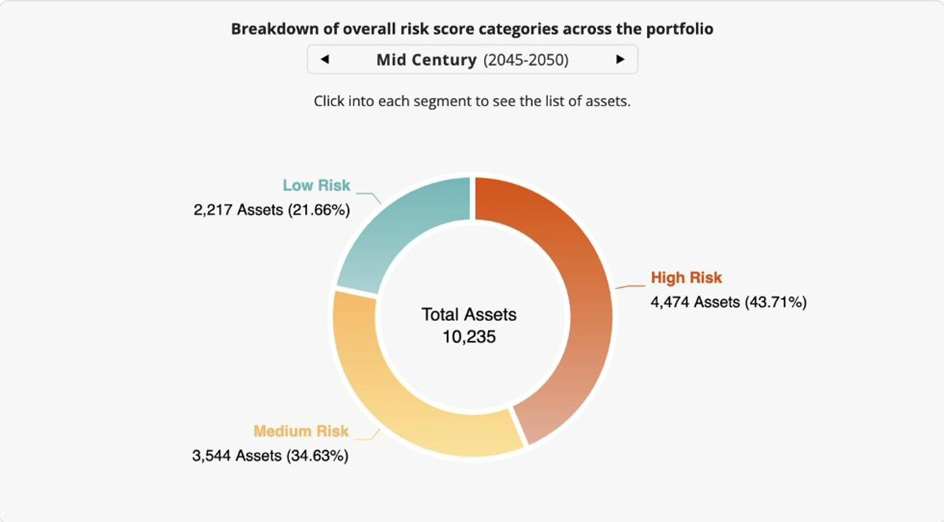
By mid-century, that rises to 43.7%. By end-century, under the same emissions pathway, nearly 70% of facilities reach the high-risk band.
3. America’s pharmaceutical supply chain is more geographically concentrated than most people realize.
Nearly four out of every five facilities registered to manufacture active pharmaceutical ingredients (APIs) for the US market are located outside the United States. India and China alone account for almost twice as many registered API facilities as the US. That concentration is usually discussed through the lens of geopolitics.
It is also a climate issue. When manufacturing clusters in a handful of regions exposed to intensifying heat and other physical hazards, localized disruptions become systemic supply-chain risks.
4. Not every part of the supply chain faces the same risk.
API manufacturing emerges as the most exposed of the three core pharmaceutical manufacturing stages, reflecting both its offshore concentration and the climate profiles of the regions in which it operates.
Finished-dose manufacturing closely mirrors the overall portfolio. Testing, packaging, and distribution remain comparatively resilient. The notable exception is veterinary and medicated feed manufacturing, where facilities concentrated across the southern United States face both extreme heat and severe hail, producing the highest overall financial losses of any supply-chain role.
5. Much of today’s projected financial loss can still be avoided.
Climate risk carries a measurable financial cost. Across the portfolio, AlphaGeo estimates a 4.9% reduction in 10-year net present value under adverse but plausible climate conditions. The encouraging finding is that most of this loss is recoverable.
Targeted adaptation measures could recover approximately 3.4 percentage points, reducing modeled losses to around 1.5%. Forward-thinkers invest in resilience before disruptions occur.
Read the full report below.
>10,000 facilities across the US’s pharmaceutical supply chain
We assessed 10,235 geocoded facilities registered to manufacture or handle drugs, active ingredients, and related products for the US market (Source: FDA Drug Establishments Current Registration Site (DECRS)).
Each facility was scored for climate risk exposure, adaptation capacity, and financial as well as operational impact.
Overall resilience-adjusted risk rises from 50 today to 56 at mid-century (and 67 by end-century on the same pathway). The share of sites in the high-risk band climbs from 32.6 % to 43.7 %, close to 4,500 of the sites that supply US pharmacies.
Heat is the dominant hazard
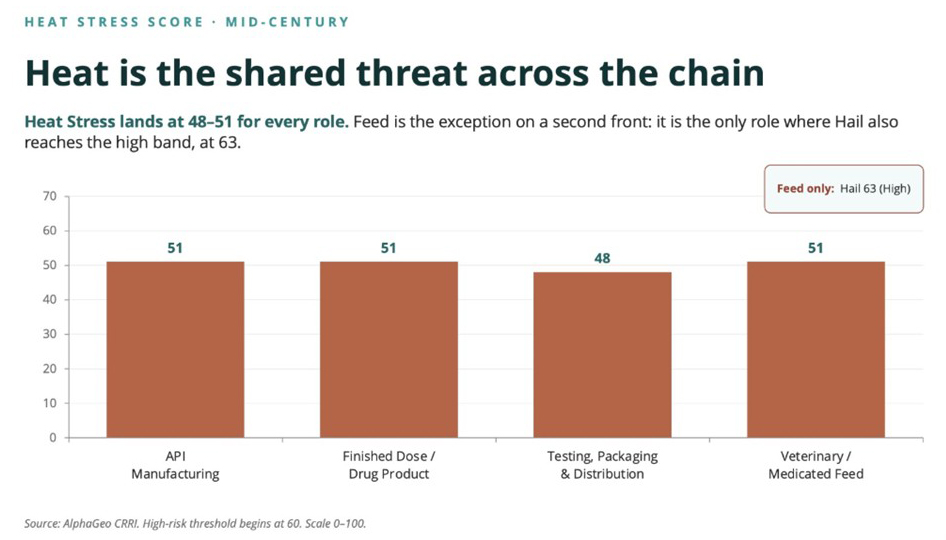
One hazard dominates. Portfolio Heat Stress climbs from 38 today to 50 at mid-century and 73 by end-century, with roughly 6,444 sites exposed to heat. Every other hazard is flatter and lower: hail at 37, hurricane wind at 23, earthquake at 19.
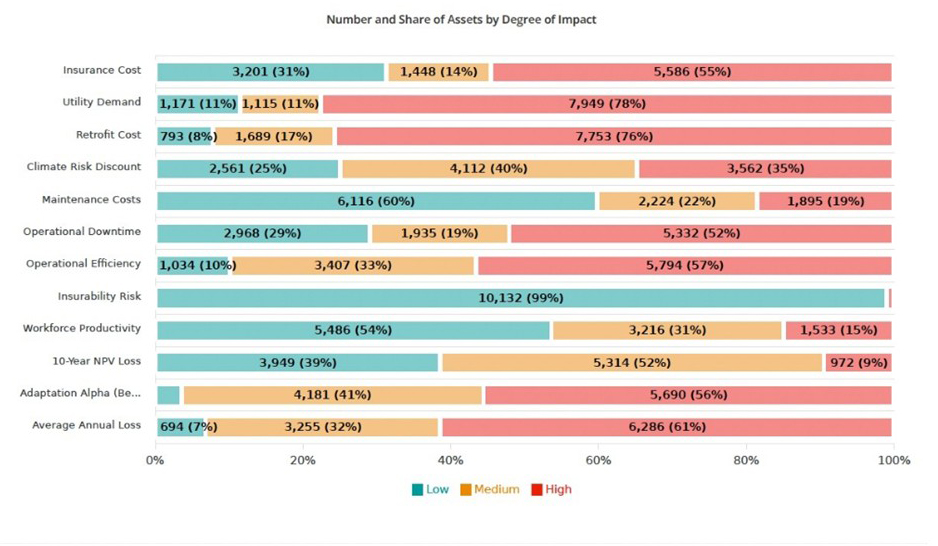
Elevated utility and cooling demand is flagged high-impact on about 99 % of sites, which for a base full of temperature-controlled processes and cold chains is the exposure that matters most.
Two regions carry most of the risk
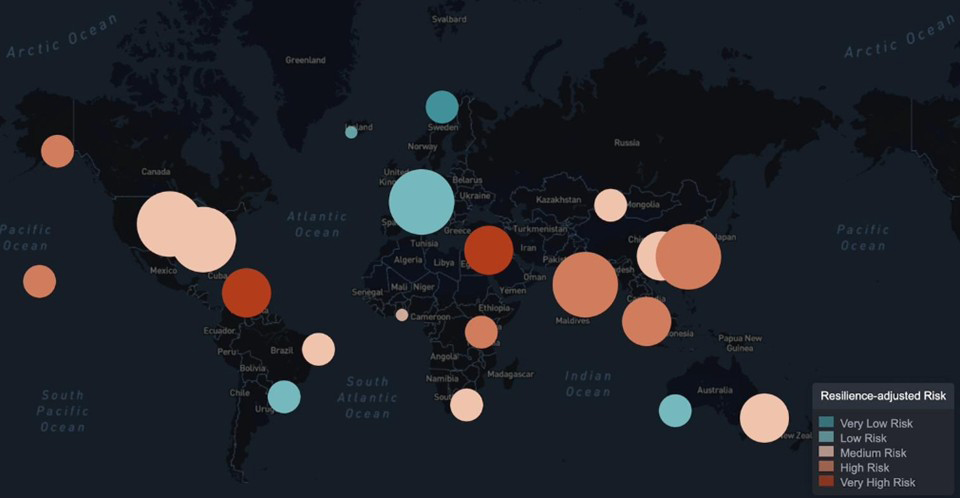
The first is the API manufacturing heartland. India and China together account for nearly twice the US share of registered API facilities, in regions where extreme heat is projected to intensify. A supply base this concentrated means regional heat events — or policy and logistics disruptions layered on top of them — are unlikely to remain local. Instead, they have the potential to ripple across pharmaceutical supply chains serving the United States.
The second cluster is smaller but more acute: Puerto Rico and the Caribbean. Facilities in this region exhibit the portfolio’s most severe forward-looking financial impacts, with modeled
- Insurance-cost increases of 27–31%;
- Projected 10-year NPV losses of 9–11%.
Examples span multiple stages of the supply chain, including Baxter Healthcare, Linde Puerto Rico, Patheon Puerto Rico, IPR Pharmaceuticals, Millicent Manufacturing, OCYON Bio, and Carib Supply St. Croix.
The financial exposure
Climate risk is more than an operational challenge — it carries a measurable financial cost.
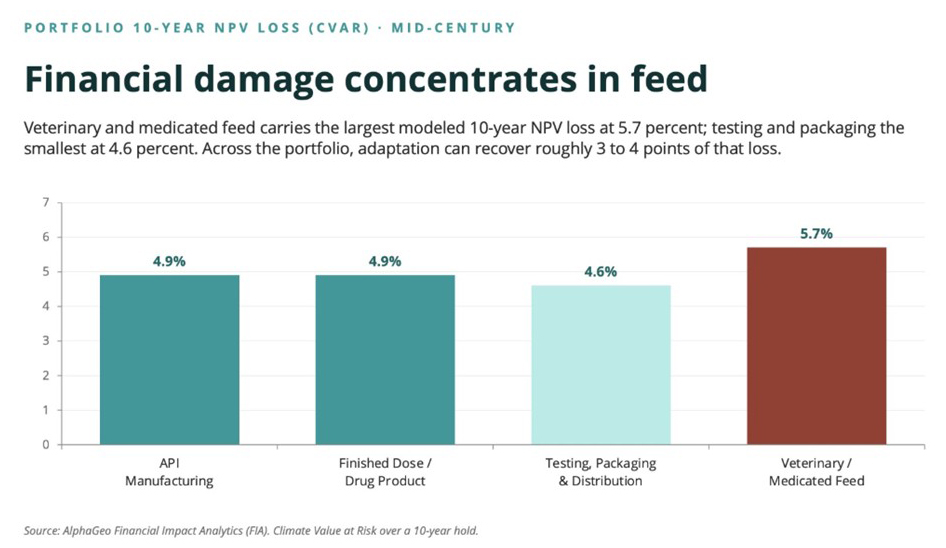
Across the portfolio, the modeled 10-year NPV loss under adverse but plausible climate conditions is 4.9% (CVaR). The more important figure, however, is how much of that loss can still be avoided. Targeted adaptation measures could recover approximately 3.4 percentage points, reducing the modeled loss from 4.9% to around 1.5%.
Financial exposure is not evenly distributed. Losses are highest in the veterinary and medicated feed segment, where projected 10-year NPV declines reach 5.7%. Geographically, the Puerto Rico and Caribbean cluster stands out as the portfolio’s financial hotspot, driven by the highest projected insurance-cost increases and NPV losses.
Not every part of the supply chain faces the same risk
Climate risk is unevenly distributed across the pharmaceutical supply chain. While extreme heat is the dominant hazard at every stage, overall exposure, financial impacts, and secondary risks vary considerably depending on where a facility sits in the manufacturing process.
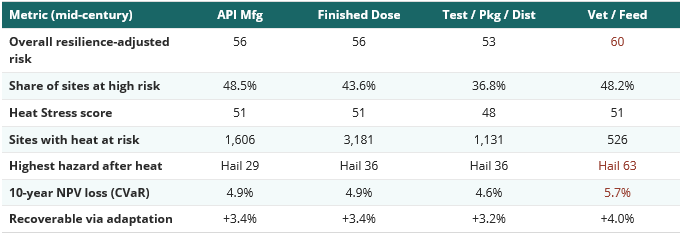
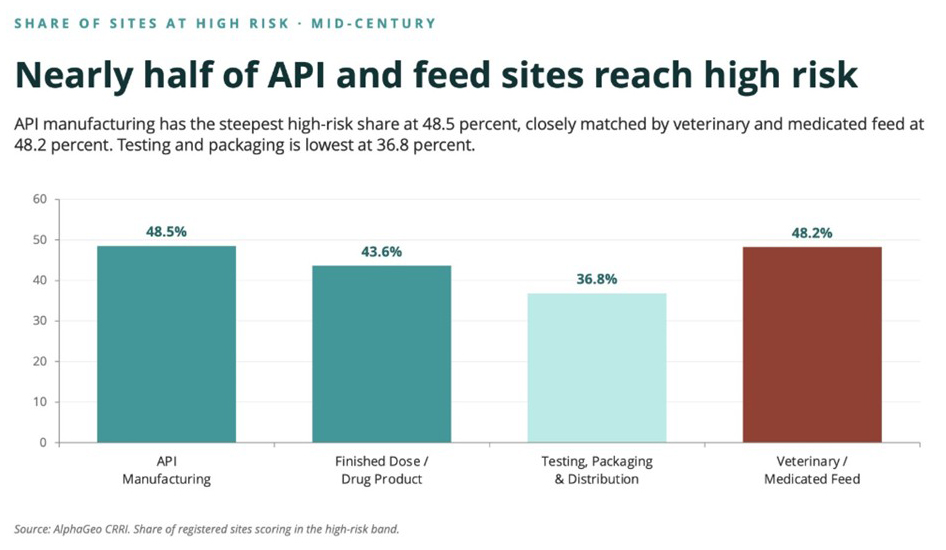
API manufacturing is both the most globally dispersed and the most exposed of the three core pharmaceutical manufacturing stages. Nearly half of all API facilities fall into the high-risk category by mid-century, reflecting the sector’s heavy concentration in regions where heat risk is projected to intensify. In many ways, API manufacturing is the physical manifestation of the pharmaceutical industry’s offshore dependence.
Finished-dose manufacturing closely mirrors the overall portfolio but accounts for the largest absolute number of facilities exposed to elevated heat.
Testing, packaging, and distribution remains the least exposed stage of the supply chain. Even so, it includes the portfolio’s single highest-risk facility: Carib Supply St. Croix, underscoring that localized hotspots can exist even within comparatively resilient segments.
Spotlight: Veterinary & Medicated Feed
One segment stands apart.
Veterinary and medicated feed records the highest overall resilience-adjusted risk (60), the largest modeled 10-year NPV loss (5.7%), and is the only supply-chain role where a secondary hazard also reaches the high-risk band, with Hail scoring 63.
The explanation is geographic. Unlike the offshore manufacturing clusters that define much of the pharmaceutical supply chain, these facilities are concentrated across the US Southern and Plains states, where rising temperatures coincide with some of the country’s highest projected hail exposure. The result is a risk profile that is fundamentally different from every other segment in the portfolio.
Go deeper with AlphaGeo
See how our Climate Resilience Suite scores your own sites, portfolios, and suppliers.
Visit alphageo.ai or contact info@alphageo.ai.
Start a free trial at app.alphageo.ai/trial_setup.