Summary: Strategic investment funds already finance the long CapEx cycle. But climate adaptation is a severely underfunded component despite its crucial role in protecting GDP as well as portfolio value and returns – the foundations of societal and economic resilience.
SIFs and the strategic imperative of climate adaptation
Sovereign and strategic investment funds (SIFs) have the capital, the time horizon and the mandate to help close the climate adaptation gap. Governments did not close it at COP31. The evidence also suggests that adaptation is one of the better-paying parts of the long investment cycle that SIFs are already funding.
How are sovereign funds changing the way they invest?
Sovereign funds are moving from passive savings vehicles to active investors with development and stabilization agendas. State-owned investors hold a record $60 trillion AUM. Many work to 30-year mandates, longer than any political cycle, which gives them room to act where markets have failed.
SIF remits now range from industrial development and economic diversification to infrastructure and climate adaptation. Domestic needs (energy, water, housing, jobs) and international needs (supply chains, trade corridors, food security) both call for patient capital that few other investors will provide.
SIFs are among the main backers of today’s wave of capital spending on power, digital infrastructure, logistics and industry. The open question is whether that spending will hold its value. Decarbonisation is one part of the answer. The other part is whether the assets can withstand the heat, floods, drought and storms they will face over their working lives.
Did COP31 deliver on adaptation?
At COP31 in Antalya, proposals to triple adaptation finance was dropped. UN Secretary-General António Guterres warned that even tripling adaptation funding would meet less than a third of current needs. UNEP’s Adaptation Gap Report 2026 puts international public adaptation finance at nearly $30 billion in 2024, against needs estimated at $305 billion a year by 2035.
Public money will not close that gap on its own. Long-term capital, including sovereign capital, will have to do much of the work.
How much GDP is at risk from climate hazards?
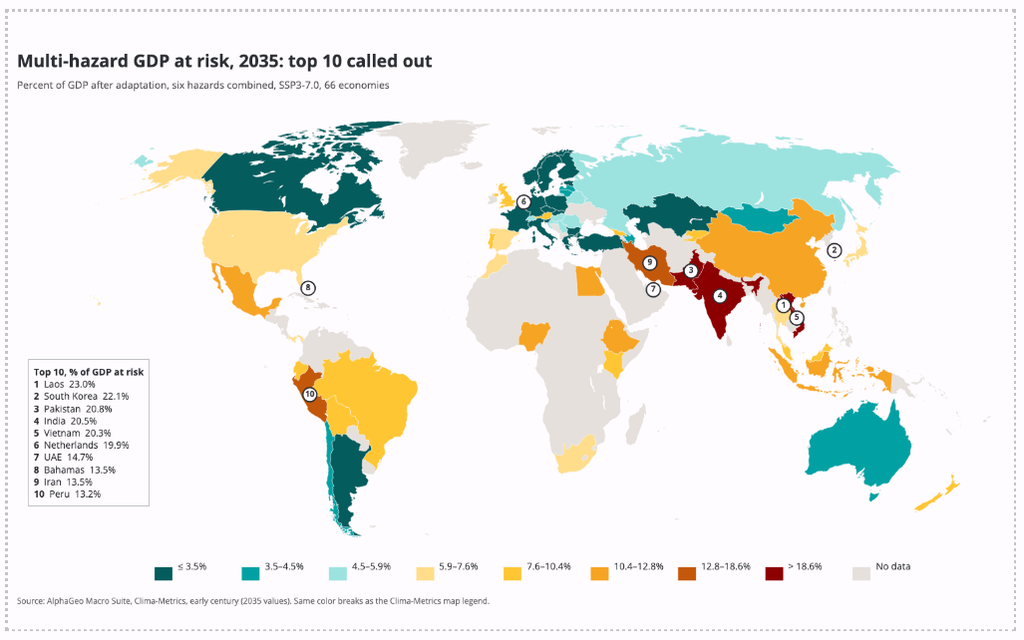
AlphaGeo’s Clima-Metrics model, part of the AlphaGeo Macro Suite, estimates GDP losses from six climate hazards across 66 economies under the SSP3-7.0 scenario, after accounting for adaptation already in place. The average economy has 7.6% of its GDP at risk by 2035 – driven primarily by heat and flooding. Adaptation measures already in place reduces potential losses by a median of 25% across the 66 economies. That is the measurable value of resilience today – and there is room to raise it.
What does climate risk mean for SIF portfolio companies?
The same hazards reach company earnings. Research published by the World Economic Forum with BCG estimates that climate hazards could cut corporate earnings by 7% a year by 2035. For a SIF, these losses show up in three places: the valuations of portfolio companies, the cash flows of infrastructure assets, and the economies where those assets sit.
Why is adaptation a local private good, not only a global public good?
Cutting emissions benefits everyone, while adaptation mostly benefits the place and the owner that pay for it: a flood barrier protects a specific port, and a cooling upgrade protects a specific data centre. That makes adaptation investable, because the owner can measure the benefit and keep it.
For SIFs this is both a domestic and an international opportunity. At home, adaptation protects the national economy and the fund’s own domestic holdings. Abroad, it is a growing asset class in the economies where climate exposure is highest.
Does adaptation pay?
The evidence says it does:
- The World Resources Institute studied 320 adaptation investments in 12 countries and found that every $1 invested yields more than $10.50 in benefits over ten years.
- Companies that assessed their risk exposure and reported to CDP estimated that their adaptation and resilience investments could yield $2 to $19 for every dollar invested (Alliance of CEO Climate Leaders and BCG).
- The World Economic Forum and BCG estimate that adaptation could be a $1.3 trillion a year market by 2030.
- The MSCI Institute studied about 2,500 listed companies and found that 43% already sell at least one adaptation product or service.
Water infrastructure shows how this works in practice. The UAE has called on investors to help close a $6.7 trillion global financing gap for water infrastructure. At home, Dubai’s AED30 billion ($8.1 billion) Tasreef programme is expanding stormwater drainage. Projects like these protect the domestic economy and produce long-term, contracted cash flows that fit SIF mandates.
Where should SIFs look for adaptation investments?
Adaptation turns climate data into physical assets. Examples include:
- Water: desalination, pipelines and storage
- Flood control: drainage, barriers and coastal defenses
- Data centers designed and sited for heat and water stress
- Distributed, grid-scale batteries that keep power running through extreme weather
These assets will make up a growing share of the long CapEx cycle. SIFs should increase their exposure to them.
How does AlphaGeo help SIFs build adaptation theses?
AlphaGeo gives asset owners the data analytics to build and test adaptation investment theses. We work with strategic funds to:
- stress-test GPs and portfolio companies for physical climate risk and resilience
- allocate capital to the most resilient funds and managers
- run long-range scenario models for economies, sectors and assets
AlphaGeo’s Financial Impact Analytics (FIA) price adaptation asset by asset: https://docs.alphageo.ai/climate-resilience-suite-crs/climate-resilience-suite-overview/financial-impact-analytics
Additionally, our Climate Price solution captures the EBITDA-at-risk to corporates and listed equities from the locations of their critical facilities and supply chains: https://docs.alphageo.ai/climate-price/climate-price
In partnership with asset owners, AlphaGeo Capital offers a platform to deploy capital into strategic long-term assets that promise income generation and capital appreciation: https://alphageo.ai/alphageo-capital/
For more background on how global mega-trends such as demographics and migration, climate and infrastructure, are colliding to reveal global market failures but generate investment opportunities for strategic investors, see our Founder & CEO Dr. Parag Khanna’s keynote to the International Forum of Sovereign Wealth Funds (IFSWF) summit in Athens from November 2026: https://crm.alphageo.ai/hubfs/IFSWF%20Khanna%202026.pdf
Talk to us
Please contact us at info@alphageo.ai to discuss opportunities for collaboration.