Summary
AlphaGeo’s analysis shows how private investment flows linked to the 2022 Inflation Reduction Act can be weighted and mapped to better understand America’s industrial investment geography. Using NLP-based company selection, multiple weighting strategies, and location analysis of major corporate sites, the article explores whether new investments are flowing into existing operating regions or expanding into new states and counties, while connecting those patterns to climate risk, resilience, and strategic location decision-making.
Introduction
For the past year, AlphaGeo has been tracking private investment flows related to the 2022 Inflation Reduction Act (IRA) reported by the White House. Our research highlights the importance of climate risk and socio-economic indicators on the financial performance of public limited companies that appear in The White House list.
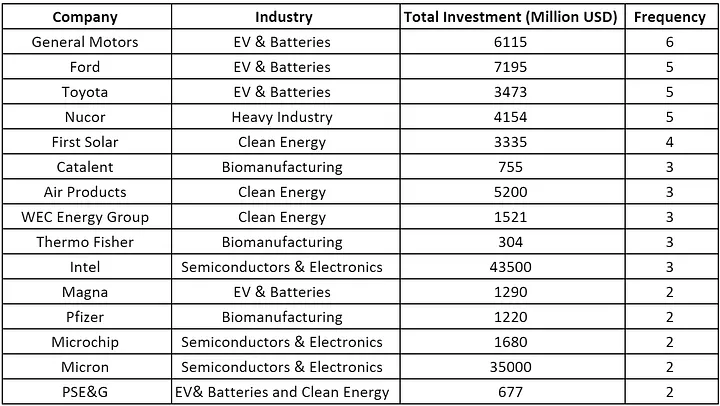
Here we focus on the top 15 firms that appear in the White House list. The Top 15 firms (Table 1) were selected using a Natural Language Processing (NLP) algorithm. We used the NLP algorithm to count the number of times a company’s name appeared in the White House list and sorted by frequency. Our research reveals that some firms have a more significant presence in the US compared to others.
This research article has two main objectives. First, we experiment with several weighting strategies to determine the most effective method for application to for analyzing the more than 1,000 companies contained in the overall White House reporting. Second, we analyze whether the new investments are being directed to existing corporate locations or if companies are investing in new states and counties. This builds on our previous work, where we analyzed the impact of climate risk and socio-economic factors on financial performance.
Weighting Strategies:
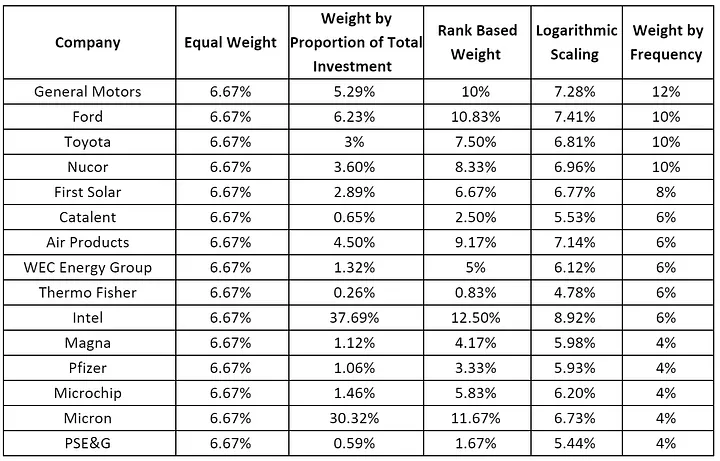
Taking the top 15 firms as a sample, we tried several weightage techniques. Below are the details of each technique. Table 2 summarizes the weight assigned to each company under these different methods.
1. Equal Weight:
We assign equal weightage to all companies. Weight is calculated by:
Weight= (1/Unique number of companies) *100
Unique number of companies = 15
Each company is assigned the weight of 6.67%
2. Weight by Total Investment reported in the White House Data:
This can be done in several ways:
Method 1: Proportion of Total Investment
This method is very straight forward. We simply take the company’s investment amount and divide it with the total investment of all 15 companies:
Weight = (Company Total/Overall Total) *100
Method 2: Rank Based Weight
This method assigns weights based on the rank of each company’s total investment. The higher the investment the higher the rank is assigned. Once the rank is assigned, we do the following calculations:
Weight = (company rank / sum of company ranks) *100
Method 3: Logarithmic Scaling
The logarithmic scaling method is used to reduce the impact of outliers or extreme values in the data. It is particularly useful when the data has a wide range of values, and you want to minimize the influence of large investments while still acknowledging them. In this method we see less variation (which is the point of using log). We first apply a log function to calculate the log totals. We use log (1 + x)) on the total investment. This transformation compresses the range of values, making large investments relatively smaller. Then we calculate the weights:
Weight = (log of company investment / sum of log investment totals) *100
3. Weight Assigned by Frequency:
In this method, weight is assigned according to the frequency of the company’s name appearing in the White House data. This is a simple and straightforward but not remarkably effective method. The weight is calculated as:
Weight = (company frequency/ sum of frequencies) * 100
Location Analysis:
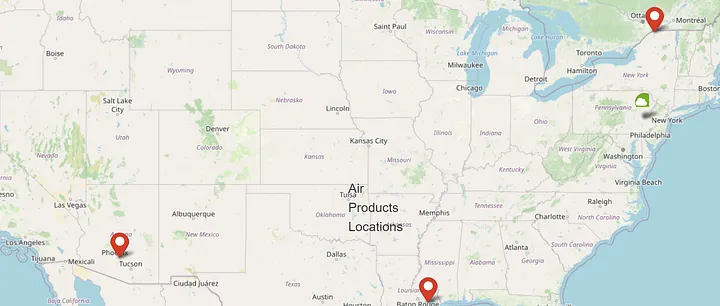
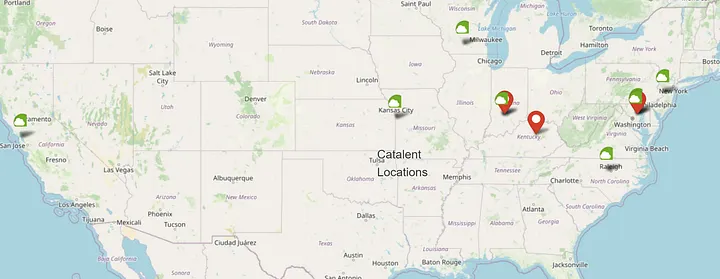
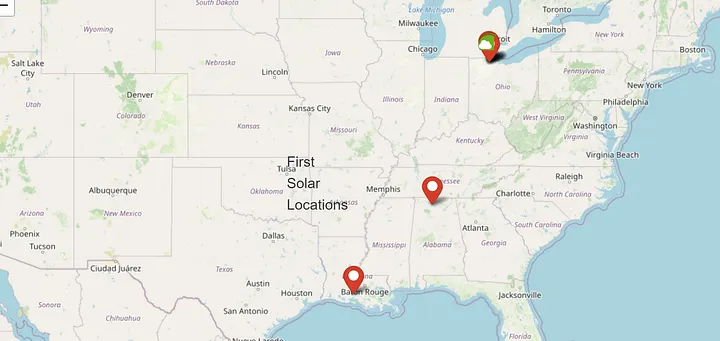
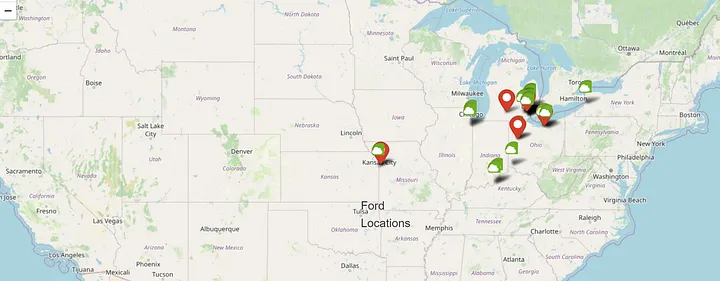
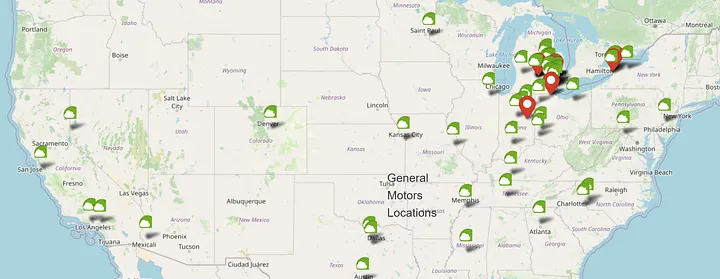
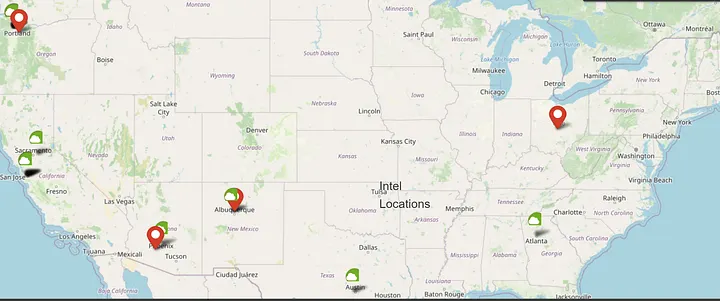
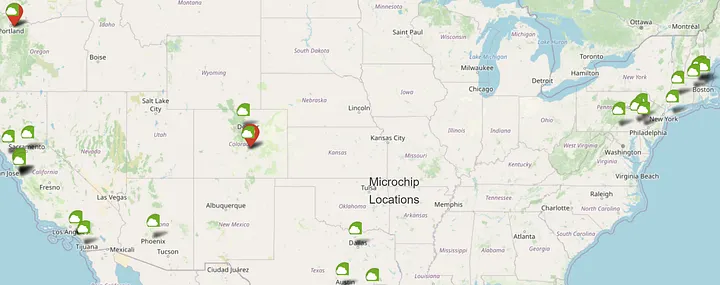
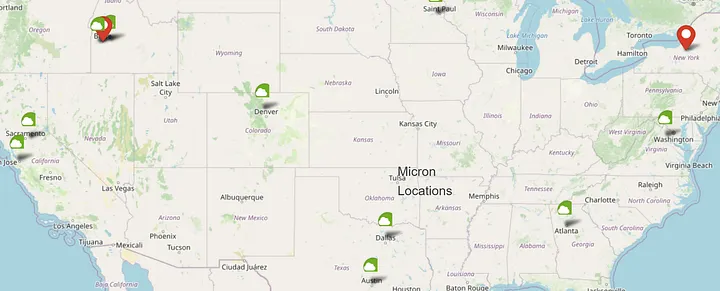
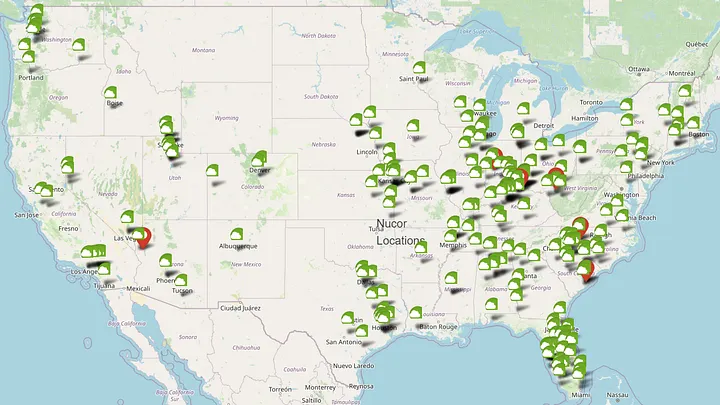
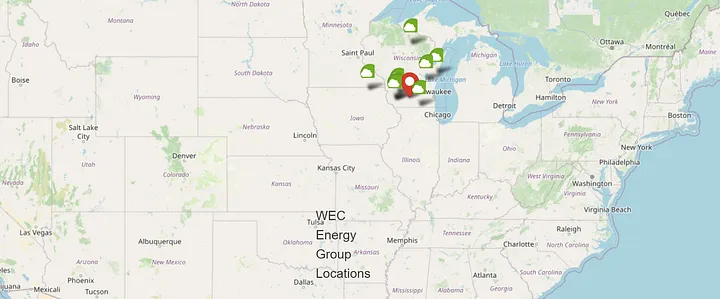
For the top 15 firms (Table 1), we constructed a database containing all major current locations of these companies in the US. Our main source of obtaining this information was company websites complemented by Google Maps. The locations were recorded down to street address and ZIP codes.
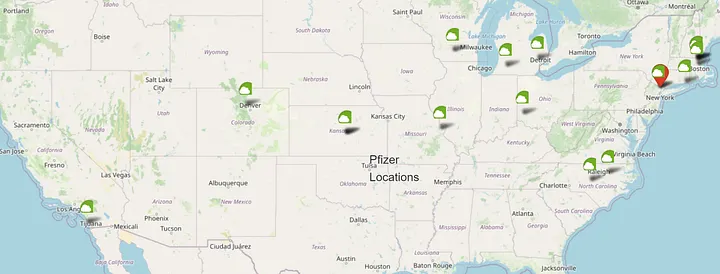
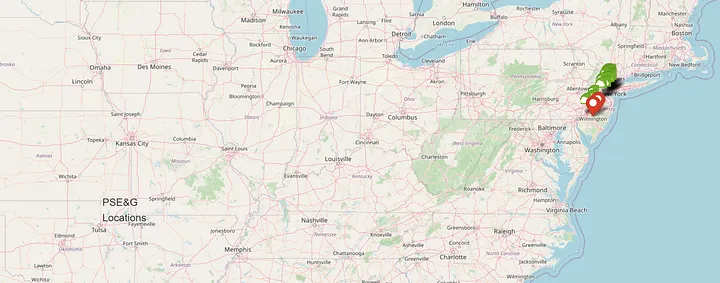
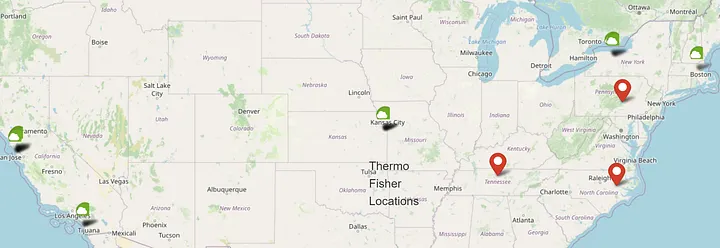
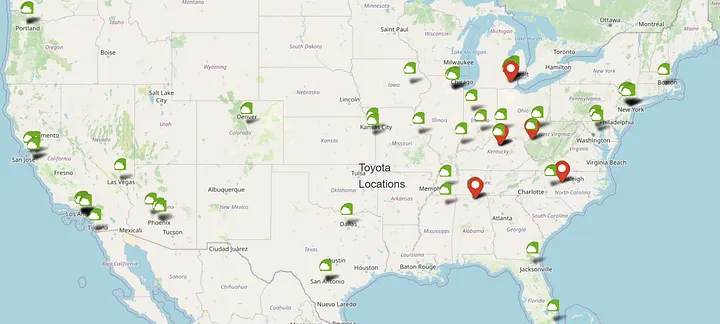
The maps below give a glimpse into the current locations of each company and the new IRT investment flow. The red represents White House Investment locations, and the green represents the data collected by
AlphaGeo of current major locations of these companies operating.
(Note: We could not locate any addresses for Magna, so for this exercise, Magna was excluded. The resulting dataset contains 14 unique companies and 502 locations. Also, some locations are missing from the data because 7 zip codes did not match the ZCTA 2020 geographic data provided by Census Bureau.)
Concluding Remarks:
The location analysis offers a granular view of the geographical presence of these firms, aiding in strategic planning and decision-making. It is evident that most companies are investing in regions where they already have an established presence. This approach is logical, as large-scale operations require substantial internal infrastructure, making it more practical to expand in areas where the company is already operational. Furthermore, this feeds into the risk versus resilience location debate and could be used to determine, which of the four scenarios attract the greatest investment flow: high risk high resilience, low risk low resilience, high risk low resilience, and low risk high resilience.
In conclusion, AlphaGeo’s comprehensive analysis underscores the nuanced relationship between climate risk, socio-economic indicators, and corporate investment strategies post-2022 IRA. By utilizing the NLP algorithm and various weighting strategies, our research highlights numerous approaches in which leading firms can allocate investments geographically. Additionally, the location analysis highlights key geographic areas for current and future investments, emphasizing the need to optimize resilience versus risk. Our findings offer valuable insights for corporate strategists to maximize investments in resilient locations while minimizing risk.
Future work will focus on further analysis of the weighting strategies and expanding the findings to include all firms in the White House list. Moreover, we aim to further investigate the flow of investment in certain geographies, answering the why and how. Ultimately,
AlphaGeo aims to help corporations make informed investment decisions in this ever-changing geopolitical and economic environment.