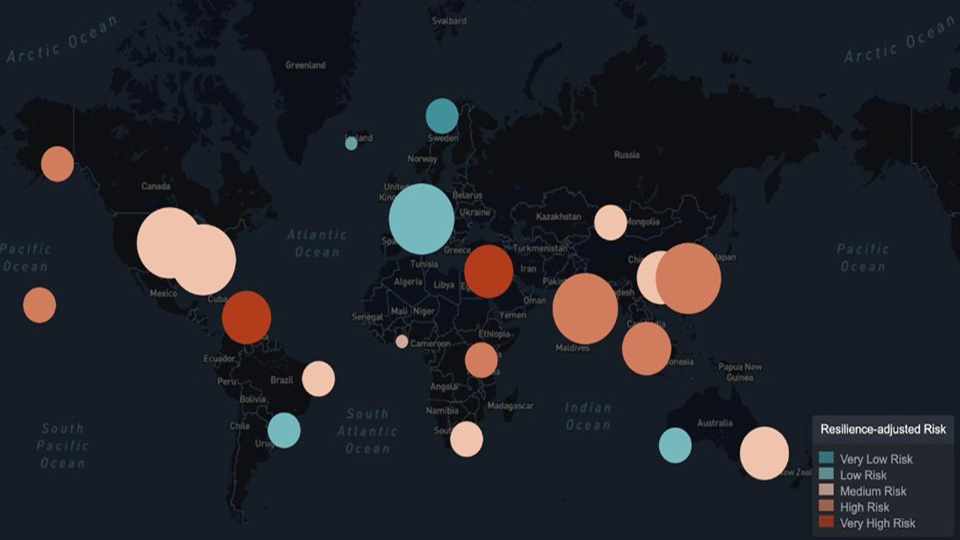
In this first installment of our Climate Resilience 101 series, we explain why and how a resilience-first approach — integrating adaptation with physical risk — should replace traditional risk-only approaches to climate change.
Introduction
The refrain is now familiar: climate volatility is accelerating. Asset managers are under pressure — from clients and regulators — to strengthen portfolio resilience against climate change. In response, many have begun incorporating physical climate risk into their investment processes.
While this is an important first step, focusing solely on physical climate risk overlooks a critical factor: local adaptation measures. Adaptation (or the lack thereof) can significantly influence how hazards impact assets in the real world. A well-adapted location will experience risks differently than a poorly adapted one, even if both share identical physical risk profiles.
Relying only on physical risk can lull investors into a false sense of security. A recent report by Singapore’s GIC and S&P argues that this approach can cause inaccurate asset risk rankings, misallocation of adaptation resources, poorly planned exit strategies, or missed investment opportunities. To address this, investors must shift from merely managing risk to optimizing resilience.
From Risk to Resilience
Resilience is a location’s ability to withstand and recover from climate-driven shocks. At AlphaGeo, we define it as:
Resilience = Risk — Adaptation
To thrive in a climate-volatile world, we advocate resilience optimization over risk minimization. This approach integrates physical climate risk with local adaptation measures, providing a more accurate “ground truth” view of climate’s real-world impact.
How Risk and Resilience Approaches Differ
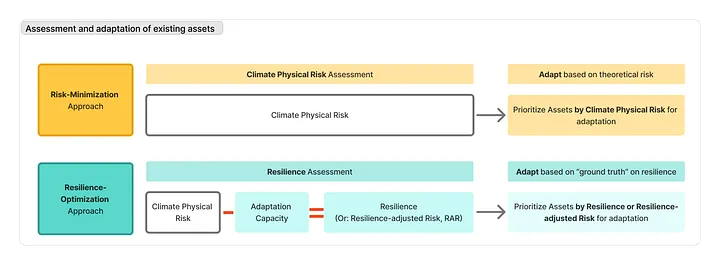
1. In assessing and adapting existing assets (Figure 2)
⚠️ Risk minimization: Starts with physical climate risk scores to plan adaptation measures.
🌱 Resilience optimization: Begins with resilience-adjusted risk, accounting for local adaptation measures (or their absence). This identifies truly at-risk assets in the real-world context.
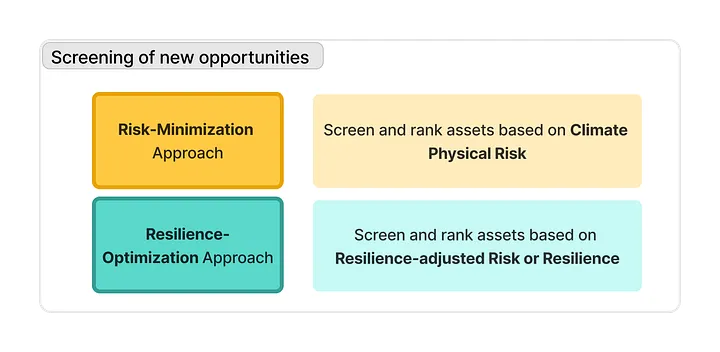
2. In screening new opportunities (Figure 3)
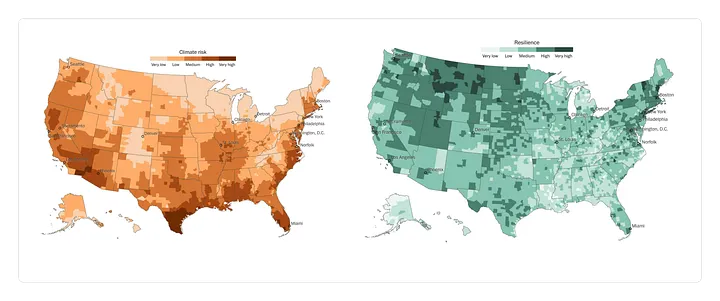
⚠️ Risk minimization: Screens assets based solely on physical climate risk, which can misrepresent real-world risk by ignoring existing adaptations. This may lead to missed or mispriced opportunities, particularly in high-demand, high-risk regions like California or Florida.
🌱 Resilience optimization: Ranks locations based on resilience-adjusted risk, offering granular insights. This enables investors to identify opportunity zones even in high-risk markets — such as those in California, Texas, or Florida, where market fundamentals are likely to remain strong despite climate risks.
Taking Action: Implementing a Resilience-Driven Strategy
This resilience-focused approach we describe is similar to those by established groups such as the Institutional Investors’ Group on Climate Change (IIGCC)’s Climate Resilient Investment Framework, which identifies adaptation capacity as a key input in physical risk assessments.
Implementation of this approach, however, has lagged due to the limited availability of market tools that integrate adaptation alongside physical risk. This issue was acknowledged in the GIC-S&P report, which noted that “a key gap in (existing) analytical models is the absence of adaptation measures that can mitigate the impact of the physical risk event”.
AlphaGeo’s Climate Risk and Resilience Index
To fill this gap, we built the AlphaGeo Climate Risk and Resilience Index — a two-in-one scoring suite that merges climate physical risk with adaptation capacity.
Unlike traditional physical risk models, our Index uses a proprietary Resilience-Adjusted Risk Methodology combining:
- Climate Physical Risk Scores: Theoretical risk baselines from climate models, transparent across time periods and emission scenarios.
- Resilience-Adjusted Risk Scores: Real-world risk levels adjusted for local adaptation capacity, based on AlphaGeo’s proprietary global adaptation dataset.
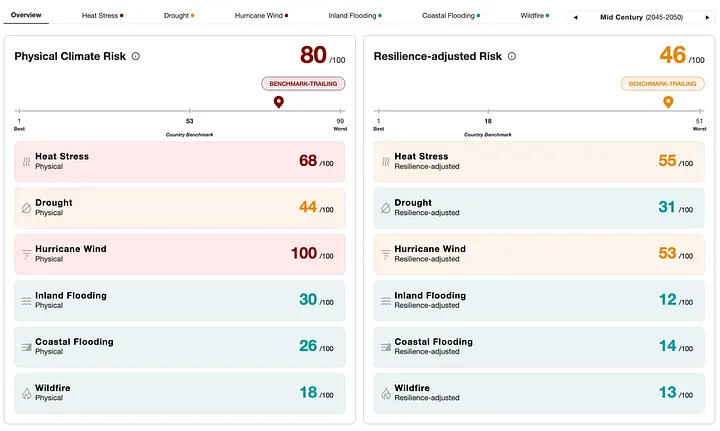
The index includes the underlying location data underpinning our scores, including our Global Adaptation Layer, a first-of-its-kind global dataset on local, hazard-specific adaptations, covering six chronic and acute hazards.
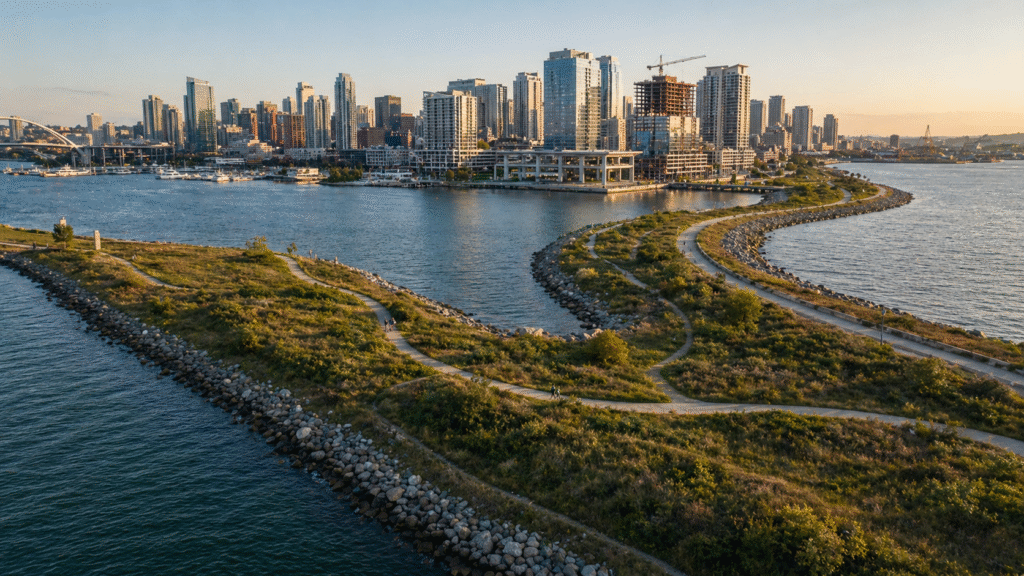
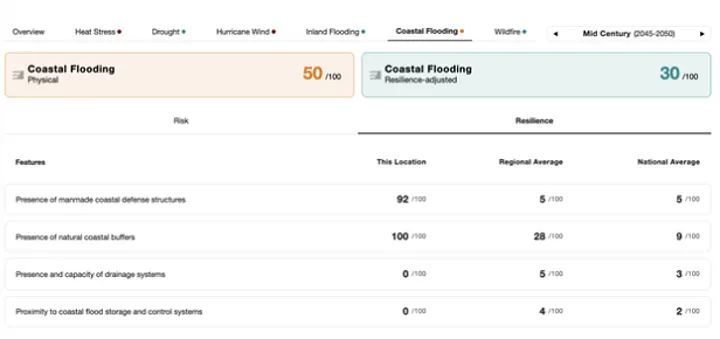
Figure 5 below shows, for example, how the adaptation features of this location — including the presence of coastal defense structures, coastal buffers, drainage systems, and flood storage systems — help reduce the resilience-adjusted risk of this location from moderate physical risk to low resilience-adjusted risk.
For more detail, refer to our Climate Risk and Resilience Index Product Guide here and learn more about the Global Adaptation Layer powering our Resilience-adjusted Scores here.
Use Cases
Our Risk & Resilience Index enables users to move beyond risk to resilience, and can be used for:
🔧 Resilience Assessments: Use resilience-adjusted scores to prioritize adaptation investment based on real-world vulnerability, optimizing the allocation of adaptation resources.
🧭 Investment Screening and Analysis: Identify high-resilience zones even within high-risk regions.
🏗️ Strategic Adaptation: Pinpoint hazard-specific adaptation gaps to inform remediation strategies.
💡 Value Creation: Find alpha in adaptation — uncovering new sources of value through investments in climate adaptation and resilience.
Conclusion
Resilience = Risk — Adaptation
The financial industry has taken tremendous steps forward by integrating climate physical risk into industry analytical frameworks. But risk itself shouldn’t be seen as the target output — rather, it is an input alongside adaptation to help optimize what truly matters: resilience.
Advancing from a risk-focused to a resilience-driven approach allows for more nuanced and realistic insights. As models begin to reflect the real-world impact of local adaptation measures, investors will be better equipped to assess both climate exposure as well as the gaps and potential for human impact, enabling actionable adaptation strategies for climate resilience.
📬 Learn More
Insights and Research: Subscribe to the AlphaGeo Insights newsletter to receive updates on our Climate Resilience 101 series, as well as other research and insights (including our series on Climate Finance).
Our Climate Risk and Resilience Index: Learn more about how our Climate Risk and Resilience Index here.
About Us: Learn more about us at alphageo.ai, or reach out at info@alphageo.ai to schedule a demo.