By Jared Carney and Parag Khanna
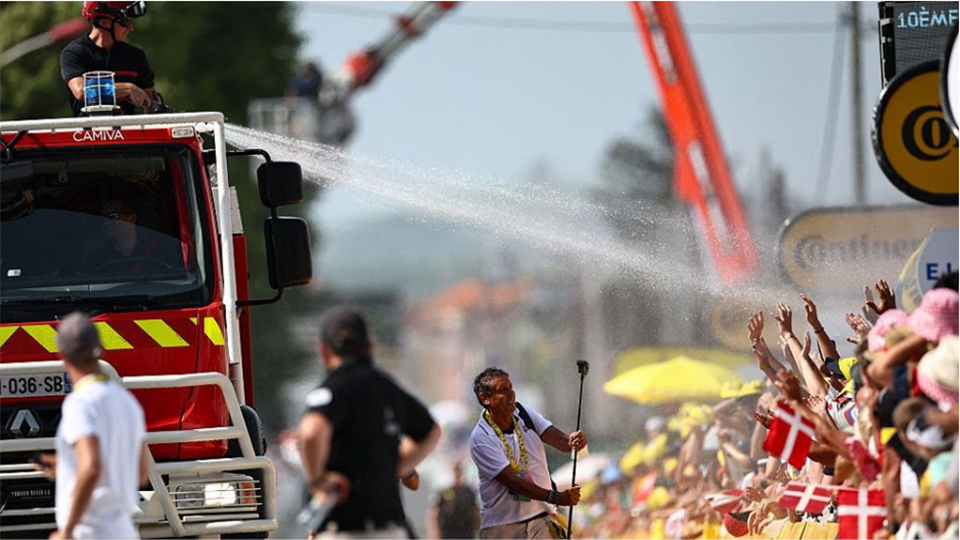
Climate change rarely announces itself. It arrives quietly, as a cycling stage stripped of its crowds, a tennis match halted twice in an afternoon, a marathon moved into the dark. Slowly, and then all at once, a warming planet is rewriting where and when the world is able to play.
Consider the past few weeks. In the Pyrenees, the third stage of this year’s Tour de France was allowed to proceed only after organizers barred spectators, as wildfires driven by 40°C heat closed roads and threatened the route. On the tennis courts, the game is buckling under the same pressure: at Roland Garros in late May, the world’s top-ranked man, Jannik Sinner, faded from two sets up in punishing heat and crashed out as the favorite; at Wimbledon this week, Flavio Cobolli and Alex de Minaur were stopped twice in a single match, once when a spectator collapsed in the sun. And at the World Cup now underway across North America, FIFA has, for the first time in the tournament’s history, written the heat directly into the rulebook, mandating a 3-minute hydration break in each half of all 104 matches, whether the stadium has a roof or not.
That is a single summer – and it is only July.
None of this is new; it is accelerating. The 2020 Olympic marathon was moved 800 kilometers north, from Tokyo to Sapporo, to spare runners the capital’s August heat. Singapore stages its marathon before dawn and runs its shorter races after dark. These are not scheduling quirks. They are the early architecture of a sport learning to survive its own venues, and the objective is blunt: to keep athletes from collapsing – and in the worst cases dying – in competition.
The implications compound. The geography of sport will move, and the sports themselves will have to bend. Expect more football played under floodlights, tennis retreating into climate-controlled halls or shortening from five sets to three, and cycling trimming the length of its stages. Winter sport faces the starkest verdict of all: within a generation, elite skiing and skating – even the Olympics – may be confined to the shrinking handful of places that can still count on snow.
We see the canaries in the coalmine. Over the past several years, the queries AlphaGeo has received include land developers seeking to certify high-elevation tracts as desirable in a world of rising seas, and from family offices deciding where to buy resilient land for future generations’ self-sufficient communities. Increasingly, the questions are about the calendar of leisure itself: where a music festival should be staged in 2027, when a race can safely be run, which Alpine valleys will still hold snow before a family commits to a chalet.
These questions are not idle, and they are not unanswerable. With the right climate and geospatial data, each can be answered with rigor and, crucially, with years of lead time. Stadiums, race calendars and host-city contracts are locked in half a decade or more ahead. The administrators signing them today are betting, knowingly or not, on the climate of the 2030s and beyond. Climate volatility is rising in a crescendo. But it is no longer so gradual that we can ignore it.
We’ve been playing not to lose instead of playing to win. That’s how games slip away.