In cybersecurity, a “zero-day” is a known vulnerability sitting quietly until the event that triggers it. Aging grids have one too: heat. Unlike a software flaw, however, this vulnerability is measurable long before it is triggered.
The setup
Summer 2026 made it impossible to ignore. During the late-June heat dome, PJM — the largest US grid, serving 67 million people — pushed to a record of roughly 166 GW. On 30 June, the Department of Energy issued emergency orders letting it curtail data centers and waive power-plant pollution limits to head off rolling blackouts. Weeks earlier, Spain and Portugal had shown how fast a stressed grid can cascade into a widespread outage.
None of these were freak events. They were the same vulnerability exposed by extreme heat exposed by extreme heat — and this trend is only accelerating.
The squeeze
A heat wave strains both sides of the power system simultaneously. Cooling load peaks while generation weakens: thermal plants derate as cooling water warms, gas turbines can lose up to a quarter of their output, solar fades in extreme heat, and transmission lines shed up to ~6% of capacity. Demand spikes precisely when supply is thinnest.
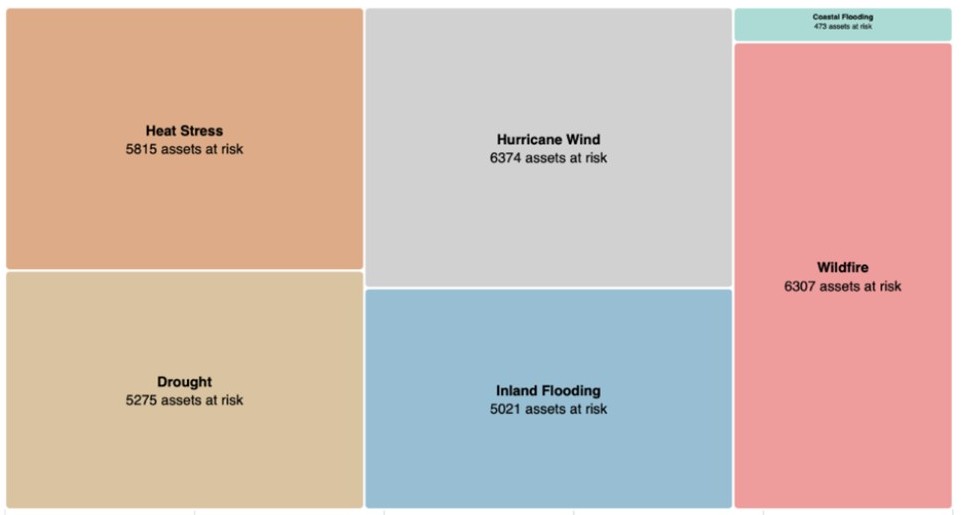
It is not a niche hazard. Across the 34,000+ plants in our Power Under Pressure analysis, heat stress is a top-three threat to generation — 5,815 assets — next to hurricane wind (6,374) and wildfire (6,307).
Physical risk by hazard type
Heat is measurable — so is the risk
The driver is quantifiable. Cooling degree days (CDD) — how far, and how long, temperatures sit above the comfort line — track heat-driven electricity demand closely. AlphaGeo correlates CDD and heat stress with service-interruption risk at the location level and projects it forward under climate scenarios. That turns “the grid feels stretched” into where and when it breaks, before the heat wave arrives.
The bill is already rising
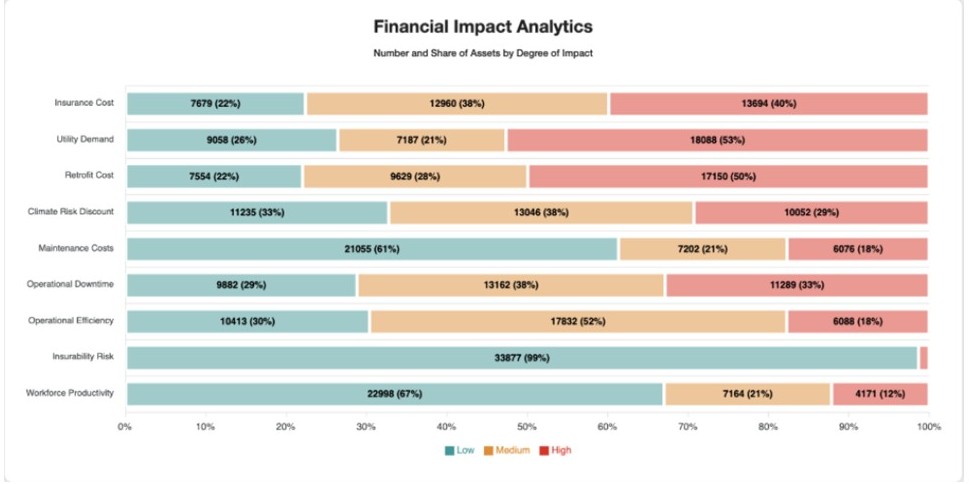
The financial impact is already material. More than 70% of power assets face moderate-to-high increases in utility demand, insurance and retrofit costs, plus operational downtime and efficiency losses. Utilities already carry climate costs several times higher than other sectors, and sector-wide exposure is set to climb into the trillions by mid-century.
Prepare – and adapt where the heat is
But while rising utility demand is a dislocation if unprepared, as Europe saw in 2022, it is an opportunity if it is planned for.
Prepare. Operators of critical load — data centers, hospitals, industrial sites — should stress-test their exposure and back it up before the event, not after.
Then invest with precision. The wave of new generation, grid hardening, storage and demand response now being financed should be calibrated to local heat and demand trajectories, not national averages — most of all where the heaviest risk sits and new capacity is being built. Our datasets are designed to guide strategic investors to be first movers in the adaptation opportunity.
The grid’s zero-day isn’t a question of if. It is a question of where — and whether the hardening and the capital arrive before the heat does.