Snow is running out. European ski resorts face increasingly warm winters, and the ski season is starting later and ending earlier. Snow cover in the Alps now lasts 36 days less than its long-term average, the shortest in 600 years, according to a Nature Climate Change study. That puts a big industry at risk. Europe has around half of the world’s ski resorts, according to the Mountain Research Initiative.
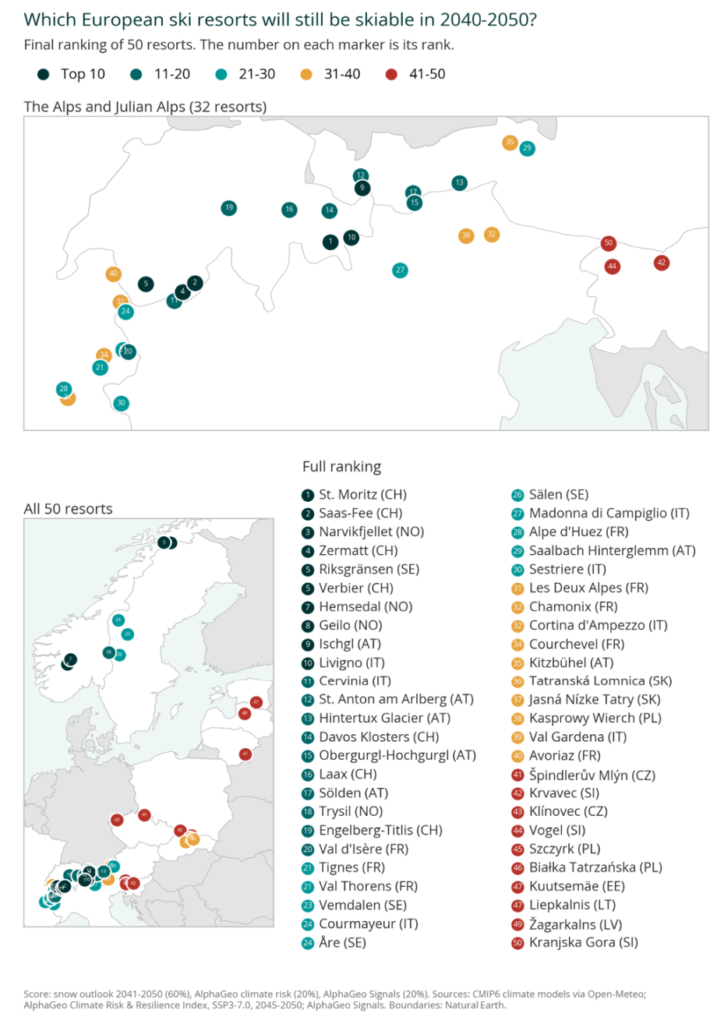
We set out to investigate which ski resorts will continue to thrive in 2050, ranking 50 leading resorts in Europe on snow availability, terrain safety, and energy and demand trajectory. We find that height and latitude matter most, with Swiss and Norwegian resorts, with St. Moritz, Saas-Fee, Narvikfjellet, Zermatt, Riksgränsen and Verbier leading in rankings.
Why snow is running out
A study of 2,234 European resorts found 53% at very high risk of poor snow at 2°C of global warming, and 98% at 4°C. As its authors explain in Carbon Brief. The ice is going too. Switzerland lost 3% of its remaining glacier ice in 2025 alone, according to the Swiss glacier monitoring network, GLAMOS. In our projections, every one of the 50 resorts warms by 1.3 to 2.6°C at mid-mountain by 2041-2050.
The ranking
The top ten is split between the high Swiss Alps and Scandinavia.
| Rank | Resort | Country | Rationale |
|---|---|---|---|
| 1 | St. Moritz | CH | Mid-mountain at 2,510 m, under one thaw day per winter, very low climate risk |
| 2 | Saas-Fee | CH | Highest mid-mountain in the set (2,700 m), despite losing points for glacier dependence |
| 3 | Narvikfjellet | NO | At 68°N, reliable snow at only about 700 m |
| 4 | Zermatt | CH | Snowfall almost unchanged by 2041-2050 |
| 5 | Riksgränsen | SE | Top-tier snow and very low risk; held back by weaker Swedish demand |
| 5 | Verbier | CH | Excellent snow; some landslide and hail exposure |
| 7 | Hemsedal | NO | Snowfall projected to rise 16% |
| 8 | Geilo | NO | Snowfall projected to rise 20% |
| 9 | Ischgl | AT | Austria’s best: high, snowy and low risk |
| 10 | Livigno | IT | Strong snow and low risk; Italy’s weaker energy and demand data pull it down |
Beyond snow
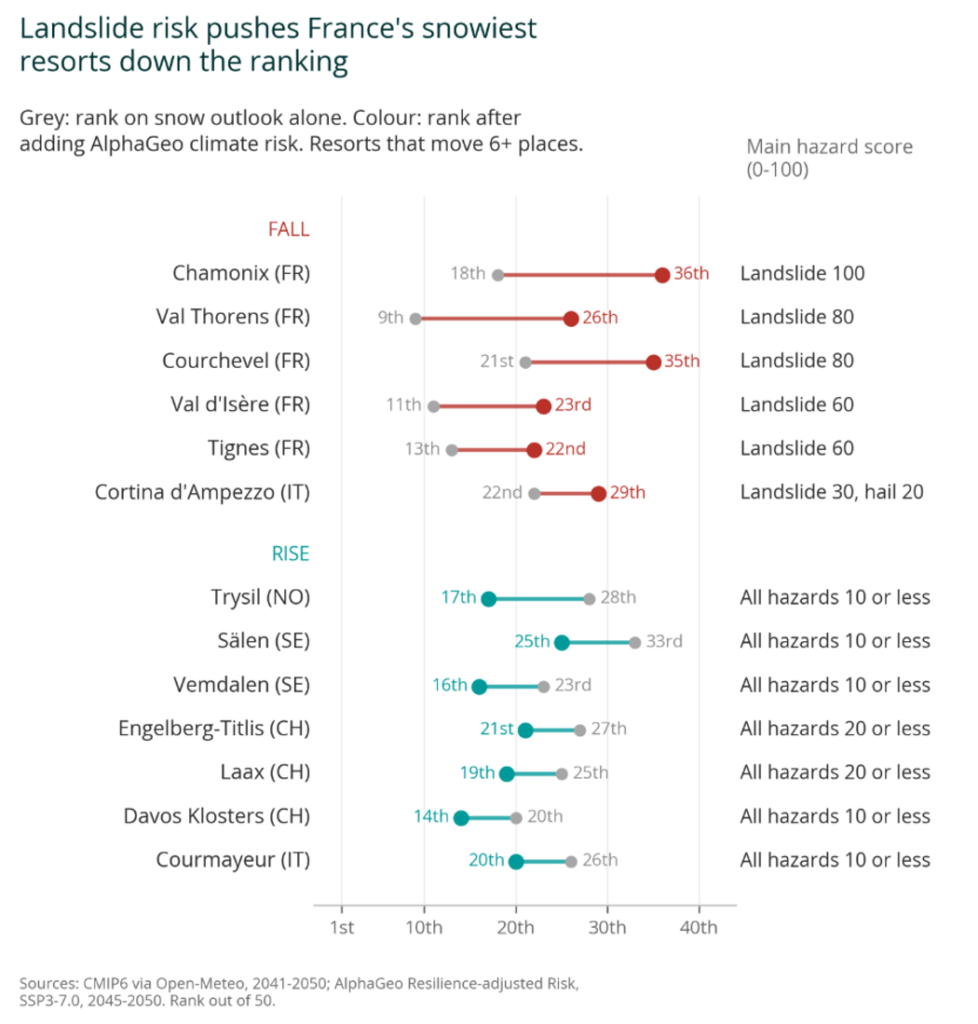
We didn’t just look at risk, but also at the overall hazard trajectory of each location. We found that the main threat besides receding winters are landslides, particularly in the steep valleys of the French Alps. Chamonix scores 100 out of 100 on landslide risk, and Val Thorens and Courchevel 80.
| How to read AlphaGeo climate risk scores Each hazard gets a score from 0 to 100. A higher score means more risk. Scores are adjusted for local resilience (human development, investment levels and the share of vulnerable people), so they reflect how exposed a place really is, not just the raw hazard. Bands: 0-19 very low, 20-39 low, 40-59 medium, 60-89 high, 90-100 very high. Hazards covered: heat stress, drought, hurricane wind, inland flooding, coastal flooding, wildfire, hail, landslide and earthquake. Landslide is based on the probability of a landslide at the location and the number of heavy-rain days a year. It is the main risk in steep Alpine valleys. Heat stress is based on days above 35°C, unusually hot days and cooling demand. It measures heat on buildings, not snow, which is why it is low everywhere here. The overall score ranks a location’s combined risk against AlphaGeo’s global coverage, so a score of 70 means riskier than about 70% of locations worldwide. We use the SSP3-7.0 scenario for 2045-2050. |
Energy and demand signals
Snowmaking needs secure, affordable power, and resorts need visitors and investment. Using AlphaGeo’s Dynamism Signals datasets on energy and demand, we find that:
- Switzerland scores near the top on energy security (82.1 on the World Energy Council’s Trilemma Index) and real home prices, a sign of property investment demand, are up 19% since 2019. Zermatt and Verbier rise four places each.
- Italy has the second-lowest energy score in the set (74.3) and flat real home prices. Livigno falls from 5th to 10th and Cervinia from 6th to 11th.
- Sweden has the strongest energy score, but air traffic is still 19% below 2019 and real home prices are down 6%. Riksgränsen slips from 2nd to 5th.
Beyond the top ten
- The far north: Narvikfjellet and Riksgränsen, at 68°N, have reliable snow at about 700 m. Hemsedal and Geilo are projected to get 16-20% more snow by 2041-2050.
- Big names at risk: Kitzbühel ranks 35th. Its mid-mountain is only 1,400 m, thaw days rise from 17 to 27 a winter and snowfall falls 13%. Saalbach (29th) and Val Gardena (39th) face the same problem.
What This All Means
- Investors and lenders: check terrain risk as well as snow. Several top French resorts score 60-100 on landslide risk, which matters for lifts, roads and property over a long hold.
- Operators: snowmaking only works where nights stay cold and power is secure. That favours Switzerland, Austria and Norway over the low resorts of Central Europe.
- Low and mid-altitude resorts: from Kitzbühel to the Baltic hills, plan for more year-round business well before 2040.
Methodology
We picked 50 well-known, highly rated resorts across the 13 markets, with at least one per country. Each resort gets a score out of 100.
- 60% for snow outlook: winter temperature, thaw days and snowfall at mid-mountain for 2041-2050 compared with 1995-2014, from three high-resolution climate models accessed through the Open-Meteo Climate API, with a penalty for resorts that depend on glaciers.
- 20% forAlphaGeo climate risk
- 20% is the AlphaGeo Signals score, which combines the six energy and demand indicators described above. Changing these weights keeps 9 or 10 of the same resorts in the top ten.
The snow projections are best used to compare resorts rather than as exact forecasts for any one resort, and they cover natural snow only. Full data and model available on request.