Even as decarbonization accelerates, the physical climate is already responding to the emissions we have put into the atmosphere. Under current policies, the IPCC’s trajectory points toward roughly +3°C of warming by the end of the century — and the risks around that path are not symmetric. Carbon keeps accumulating, and the climate system carries the prospect of tipping points and self-reinforcing feedback loops — ice-sheet loss, permafrost thaw, forest dieback — that could push outcomes well beyond central estimates. The practical implication for investors is simple: physical climate risk is now a financially material, here-and-now variable, not a distant scenario.
Adaptation is moving to the center
That realization is reshaping how capital is allocated. Adaptation — building resilience to climate impacts rather than only working to prevent them — has moved from the margins of climate policy into a recognized investment theme, and the shift is visible across governments, corporates and markets alike:
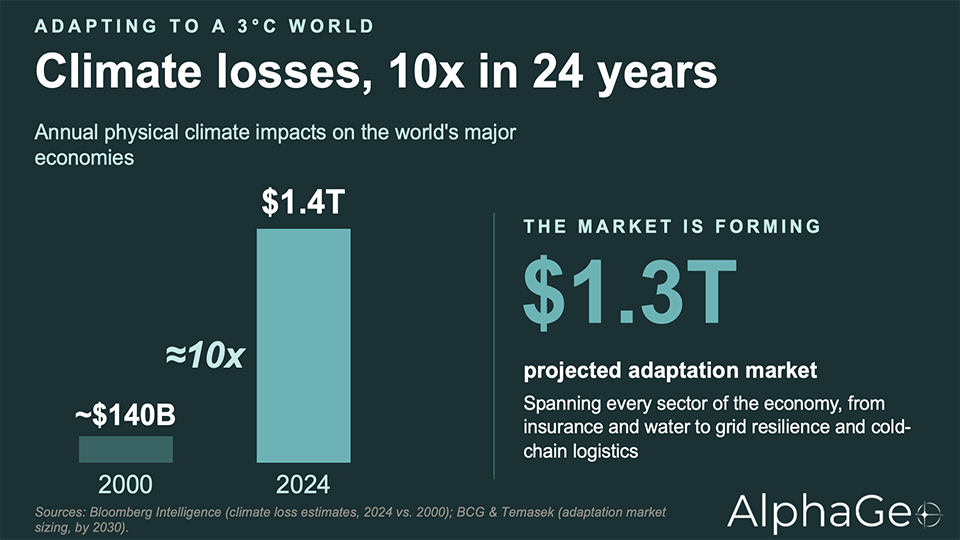
- The losses are already enormous. Physical climate impacts cost the world’s major economies an estimated $1.4 trillion in 2024, according to Bloomberg Intelligence — close to ten times the figure recorded in 2000.
- Governments are treating resilience as strategy, not just cost. In late 2025, BloombergNEF launched an adaptation-preparedness scorecard for major economies, with Canada, Singapore and South Korea ranking among the most prepared.
- The market is being sized accordingly. A United Nations study projects that private investment in climate adaptation will approach US$1.3 trillion a year by 2030 — a figure Bloomberg echoes in framing adaptation as a roughly $1.3 trillion market spanning every sector of the economy.
AlphaGeo’s lens: measuring the adaptation gap
At AlphaGeo, we see adaptation as one of the defining investment themes of the decade — and one that is fundamentally geospatial. Demand for resilience is local. It depends on where the hazards are, and on where existing defenses fall short.
We measure that mismatch directly, across a wide range of infrastructures and services. Our Global Adaptation Layer captures adaptation measures — both engineered and nature-based — across nine hazards, including inland and coastal flooding, while our Resilience-adjusted Risk scores pinpoint places that are high-risk yet poorly adapted. The space between the two is the adaptation gap: the clearest signal of where demand for resilience products and services will grow, and how large those markets could become.
Read more: Thematic Investing in Adaptation
The market is already pricing it in
This is not a thesis waiting for validation. Bloomberg’s Prepare and Repair Index — roughly 100 large public companies across sectors tied to disaster preparation and recovery — outperformed the S&P 500 by about 6.5% a year over the decade to October 2025. Alongside it, the arrival of dedicated adaptation-preparedness scorecards and resilience-themed benchmarks signals that investors are no longer treating adaptation as a niche — they are actively building the tools to find the companies best positioned for a world of more frequent, more intense shocks.
Companies that stand out
Across the listed universe, a handful of companies stand out for how directly their core businesses map to adaptation demand. A few we’d highlight:
Insurance & risk transfer. Marsh McLennan (US) pairs climate risk modeling and advisory with parametric insurance structures — triggered by predefined wind or rainfall thresholds — to close protection gaps and speed payouts for corporates, insurers and governments. Willis Towers Watson (WTW) brings catastrophe modeling and its Climate Quantified platform to insurers, reinsurers and corporates, translating physical risk into forward-looking financial scenarios.
Early warning. Hexagon’s HxGN OnCall platform underpins emergency-response and public-safety operations — part of the digital backbone enabling faster, smarter responses to hazards.
Engineering. Vinci (France) delivers large-scale coastal and maritime works — seawalls, breakwaters and storm-surge protection — for governments and infrastructure clients. Veolia (France) leads in water, desalination and treatment, expanding potable supply for municipalities and industry in increasingly water-stressed regions.
Off-grid energy & cold-chain. As grids face more frequent disruption, Sungrow (China) and LG Energy Solution (South Korea) supply the battery storage and backup systems that keep homes, businesses and critical infrastructure running through outages and extreme weather. DSV (Denmark) complements them with the temperature-controlled, cold-chain logistics that keep food and pharmaceutical supply chains stable as heat stress intensifies.
Where AlphaGeo fits in
These are companies whose growth is tied to the adaptation gap closing — and they are exactly the kind of partners we want to work with. That is where our data adds value, not only for investors screening for exposure, but for the providers themselves. AlphaGeo helps adaptation companies map where their solutions are most needed: overlaying localized hazard and resilience data to quantify demand, size addressable markets, and surface the whitespace where their services can expand.
In a 3°C world, knowing where resilience is missing is the foundation of both a sound portfolio and a growing business.