A new special report maps 28 million movements across the Middle East and North Africa (MENA) and projects where people will relocate in the years ahead.
This white paper – Modeling MENA Migration: Flows, Drivers and Policy Implications (2021–2026) – is co-authored by AlphaGeo Founder & CEO Dr. Parag Khanna and Research Associate Ikram Ellouali, and published by the prestigious Anwar Gargash Diplomatic Academy (AGDA).
Migration across the Middle East and North Africa is usually reported one crisis at a time. This new AlphaGeo special report published by the renowned Anwar Gargash Diplomatic Academy (AGDA) treats it as a single system. It builds a bilateral origin-destination matrix covering 29 countries and more than 500 potential corridors for the period 2021–2025, then projects those corridors forward into 2026 and beyond using the geopolitical events that have already broken the historical pattern.
Three findings stand out. Conflict displacement and Gulf-bound labor migration account for nearly all high-volume movement. The Iran war has introduced the largest new displacement variable since the Syrian civil war. And climate stress is already visible in the baseline data at the province level.
The 2021–2025 baseline
Of more than 500 possible country pairs, only 67 exceed 10,000 cumulative movements. The mapped corridors account for roughly 23.9 million people, and the largest ten carry most of that volume. Syria to Turkey is the single biggest bilateral corridor at 2.6 million. Afghanistan produces the largest total outflow of any origin country at approximately 5.9 million, split almost evenly between Iran and Pakistan.
Saudi Arabia is the largest destination in the dataset with 6.88 million cumulative arrivals, driven almost entirely by labor rather than forced displacement. Those flows come from Pakistan, Yemen, Egypt, Sudan and Jordan, and they are captured through GASTAT and IOM sources rather than UNHCR, which is one reason they are routinely undercounted in refugee-led analysis.
Table 1. Largest bilateral corridors by cumulative stock, 2021–2025
| Corridor | Cumulative stock |
|---|---|
| Syria to Turkey | 2,600,000 |
| Afghanistan to Iran | 2,500,000 |
| Afghanistan to Pakistan | 2,500,000 |
| Palestine to Jordan | 2,400,000 |
| Pakistan to Saudi Arabia | 1,800,000 |
| Yemen to Saudi Arabia | 1,800,000 |
| Egypt to Saudi Arabia | 1,500,000 |
| Sudan to Saudi Arabia | 820,000 |
| Syria to Germany | 760,000 |
| Sudan to Egypt | 737,000 |
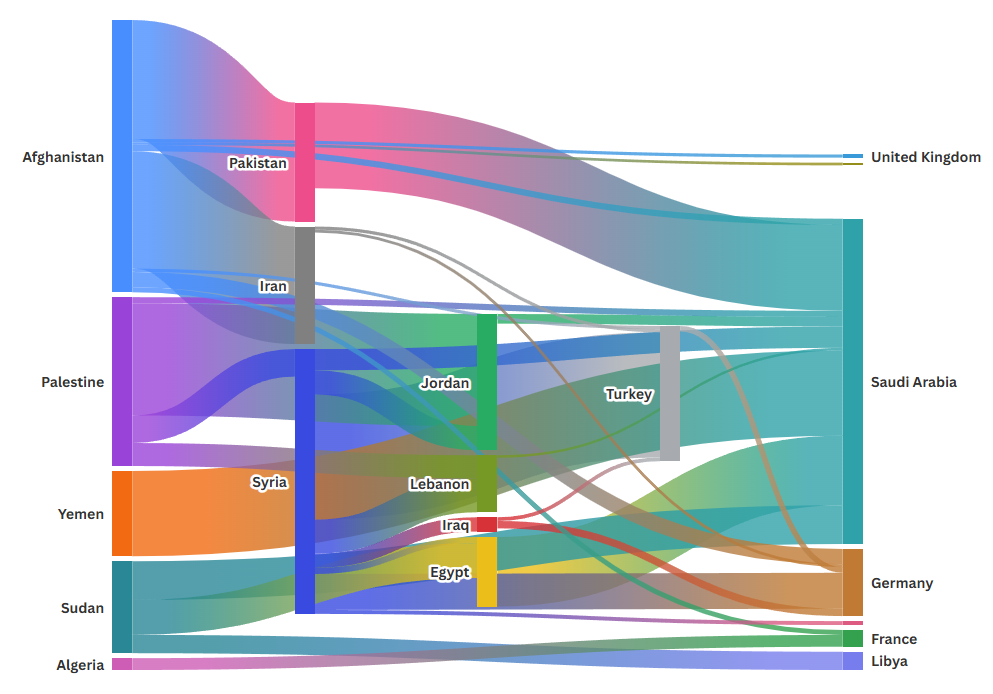
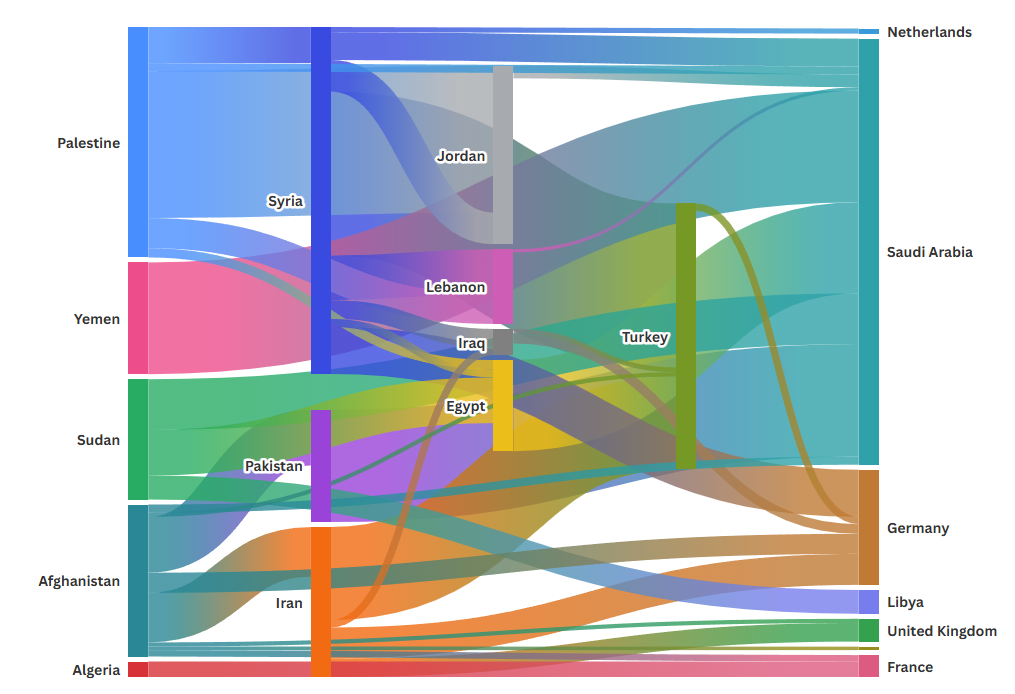
Figure 1. Major bilateral migration corridors, 2021–2025. Origins are listed on the left, destinations on the right, and band width is proportional to the volume of movement. Filtered to corridors of 50,000 or more cumulative migrants. Four structural patterns dominate: conflict displacement from Syria, Afghanistan, Palestine and Sudan; labor migration toward the Gulf; intra-regional hosting by Turkey, Jordan, Lebanon, Iran and Pakistan; and North Africa to Europe mixed migration.
The Iran war and the 2026 projection
The Iran-Israel-United States conflict of early 2026 introduced a corridor that barely existed in the 2021–2025 data. US-Israel operations in February 2026 internally displaced 3.2 million Iranians. Cross-border movement is still limited, however, at roughly 1,300 people per day through Turkey across the 1,600 km shared border. The war also degrades the Gulf as a labor destination: after the March 2026 strike on Dubai’s Jebel Ali port, the report holds all Gulf-bound labor corridors flat rather than projecting growth.
| On method. The projection is deliberately conservative. Each corridor is set at its 2021–2025 annual average, then adjusted only where current evidence contradicts that average: downward for Afghanistan to Iran and Afghanistan to Pakistan, given active deportation campaigns, flat for Gulf labor, and upward for Iran as a new origin country. |
Where 2026 out-migration is projected
Aggregated across all inbound corridors, four destinations absorb most of the projected movement. Saudi Arabia remains the largest at 1.38 million projected annual arrivals. Turkey rises to 859,000, elevated by the Iranian surge. Jordan takes 577,000, driven by Palestinian and Syrian flows. Germany, at 372,000, is the main long-distance destination.
Table 2. Projected annual arrivals by destination, 2026
| Destination | Projected arrivals | Principal origins |
|---|---|---|
| Destination | Projected arrivals | Principal origins |
| Saudi Arabia | 1,380,000 | Pakistan, Yemen, Egypt, Sudan, Jordan, Lebanon |
| Turkey | 859,000 | Syria, Iran, Afghanistan, Iraq |
| Jordan | 577,000 | Palestine, Syria |
| Germany | 372,000 | Syria, Afghanistan, Iran, Iraq, Turkey, Algeria |
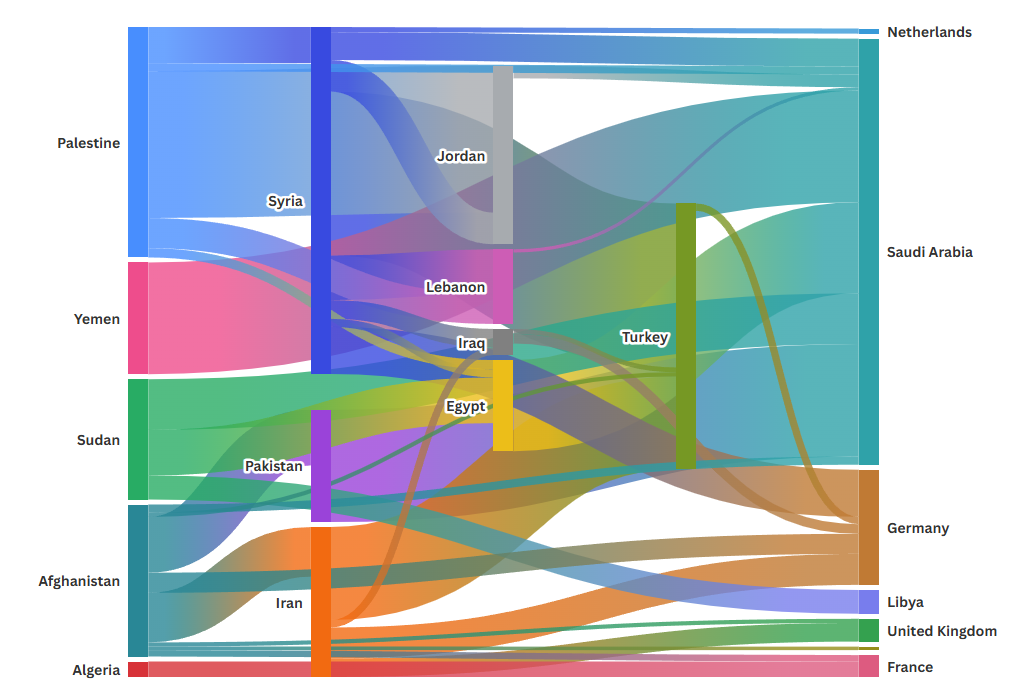
Figure 3. Projected bilateral migration corridors, 2026. The same corridor structure recalculated as projected annual arrivals rather than multi-year cumulative stock. Two corridors absent from the baseline appear here: Iran to Iraq, and Palestine to Egypt. Algeria to France is added from OECD data. All corridors shown exceed 10,000 projected annual arrivals.
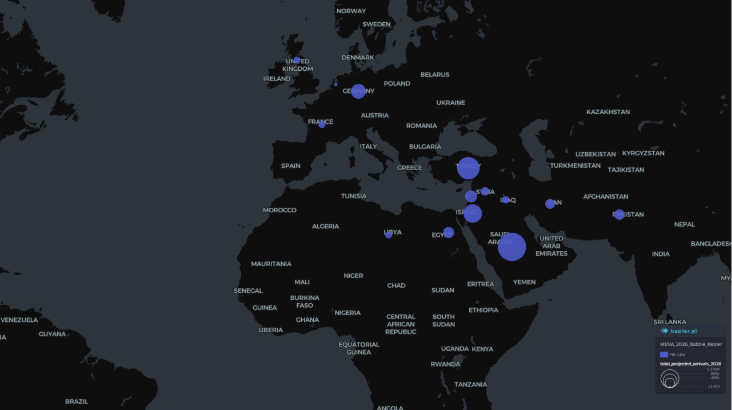
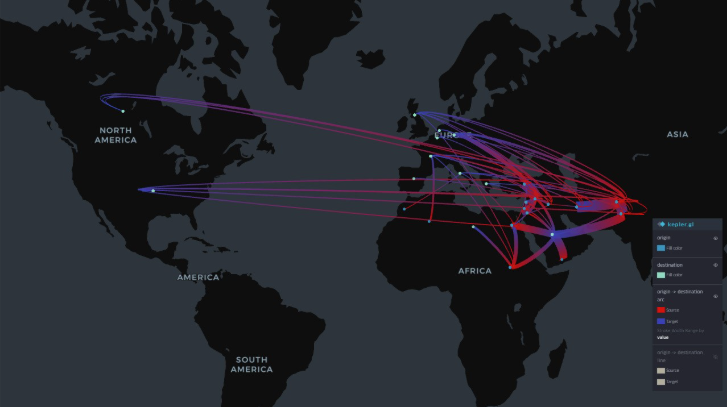
Figure 4. Geographic absorption map: projected migrant destinations, 2026. Circle size is scaled to total projected annual arrivals aggregated across all inbound corridors. The map complements the corridor view above by showing where movement terminates rather than where it originates.
Climate pressure is already in the 2021–2025 data
The report adds a province-level overlay. Rather than ranking countries by climate vulnerability, it identifies the specific subnational units already generating outbound movement, then maps the hazard mechanism driving departure in each.
- Basra, Iraq. Heat above 51°C combines with saltwater intrusion and water contamination. Tigris-Euphrates output is down 30–40% over 40 years.
- Hadramawt and Taiz, Yemen. Groundwater is falling 2–6 meters per year. Terraced agriculture has collapsed and there is no adaptive fallback.
- Helmand and Kandahar, Afghanistan. Groundwater depletion is described as irreversible. In documented villages, roughly 50% of families left after wells dried up.
- Sistan-Baluchestan, Iran. A 72% rainfall decline dried the Hamoun wetlands. Water bankruptcy was declared in 2025 and departure is already under way.
- North and West Darfur, Sudan. The Sahara is advancing 1.5 km per year, removing rainfed farmland and driving pastoralist-farmer conflict.
These provinces are already generating outflows. They feed the corridors mapped in the 2021–2025 baseline, which is why the report recommends that destination countries build a climate-origin fast track: a pre-approved processing category for migrants from designated high-risk provinces, established in advance of the next climate shock.
Islamic solidarity and EU containment
Islamic solidarity is rhetoric, not a policy framework. No Muslim-majority country in the network extends formal religion-based preference in asylum or residency. Shared identity shapes political language, not law. Pakistan deported 1.7 million Afghans between 2023 and 2025 and Iran expelled 750,000 more, while a 2024 petition in Turkey sought to strip citizenship from 238,000 naturalized Syrians. Qatar is the only GCC state with a domestic refugee law, and it does not privilege Muslims.
Containment is not a migration policy. The EU committed more than €906 million to migration management in North Africa between 2021 and 2024, pledged €7.4 billion to Egypt and €624 million to Morocco. The report calls the result a managed dependency: recipient states are paid in ways that reward restriction over integration, which sustains populations in legal limbo instead of resolving their status. Saudi Arabia’s abolition of kafala in June 2025 is the most significant Gulf reform in a generation, but it has been applied selectively and excludes domestic workers.
What the report recommends
Recommendations are organized by destination country and ranked by cumulative migrant stock.
- Saudi Arabia. Extend kafala abolition to domestic workers, mandate sector portability, and add a grievance mechanism with access to labor courts.
- Jordan. Open Jordan Compact work permits to all registered refugees rather than Syrians only and create a dedicated agricultural permit category with transport and safety standards.
- Turkey. Remove the geographical limitation on the 1951 Convention and grant full status rather than temporary protection.
- Germany. Add a vocational fast track to the Skilled Workers Immigration Act and weight the Königstein Key by employment proximity as well as tax revenue and population.
- Egypt. Complete biometric registration for 800,000+ refugees before transferring status determination from UNHCR to the national committee.
- European Union. Redirect Libyan Coast Guard funding toward managed resettlement processing in Tunisia and Egypt, and toward climate-specific resettlement quotas.
| FULL REPORT Modeling MENA Migration: Flows, Drivers and Policy Implications (2021–2026) The full report includes the complete origin-destination matrix, the migration driver assessment by origin country, the emerging population hubs table, the province-level climate overlay, and country-by-country policy analysis. → Read the full report (AGDA) → Interactive Sankey: baseline corridors, 2021–2025 → Interactive Sankey: projected corridors, 2026 |