Executive Summary
The geography of wealth is being redrawn — and the pace is accelerating.
Since the COVID-19 pandemic, an estimated 500,000+ millionaires have relocated internationally — marking the largest sustained wealth migration in any historical period. (Source: Henley & Partners Private Wealth Migration Report, 2025.)
This is a structural reconfiguration of where private capital is held, where trophy real estate is bought, and which cities will anchor the next generation of UHNWI wealth.
AlphaGeo’s mission is to guide resilient investing – and here we apply our expertise in predictive location analytics to forecast the resilience of emerging wealth magnets to guide investor decision-making for their crucial long-term real estate allocation.
The Old Consensus
From 2013 to 2019, millionaire migration flowed toward a stable set of destinations. Australia, Singapore, the USA, Canada, and Switzerland absorbed the majority of globally mobile wealth year after year. These markets shared a common profile: transparent rule of law, mature financial infrastructure, and established UHNWI ecosystems. For family offices and institutional investors, real estate in these countries was as close to a risk-free store of value as residential property gets.
That consensus has broken down.
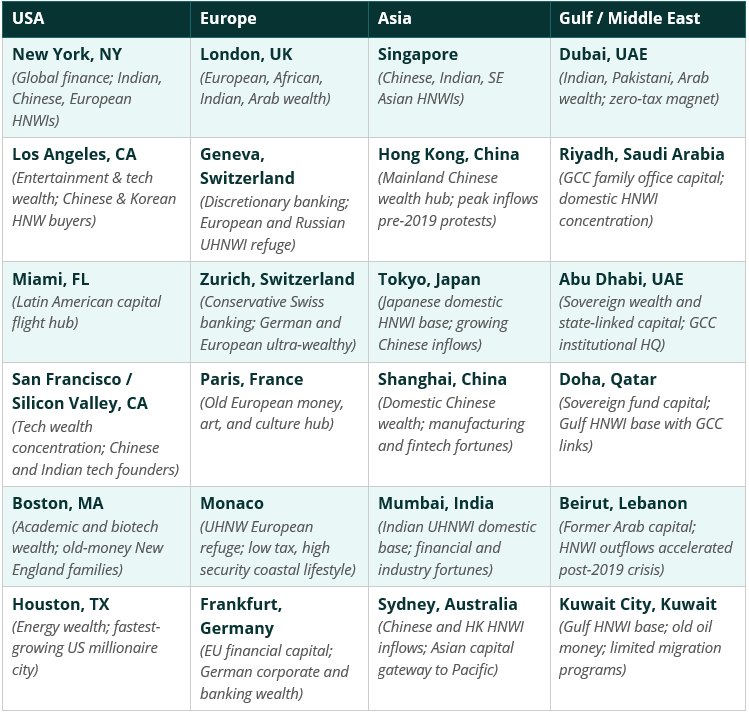
Old Money Hubs: Where Wealth Concentrated Before 2020
The table below maps the traditional wealth hubs that dominated HNWI flows through the 2000s and 2010s — and the nationalities that drove demand within each.
Where Wealth Is Moving Now: The Top 15 Destinations
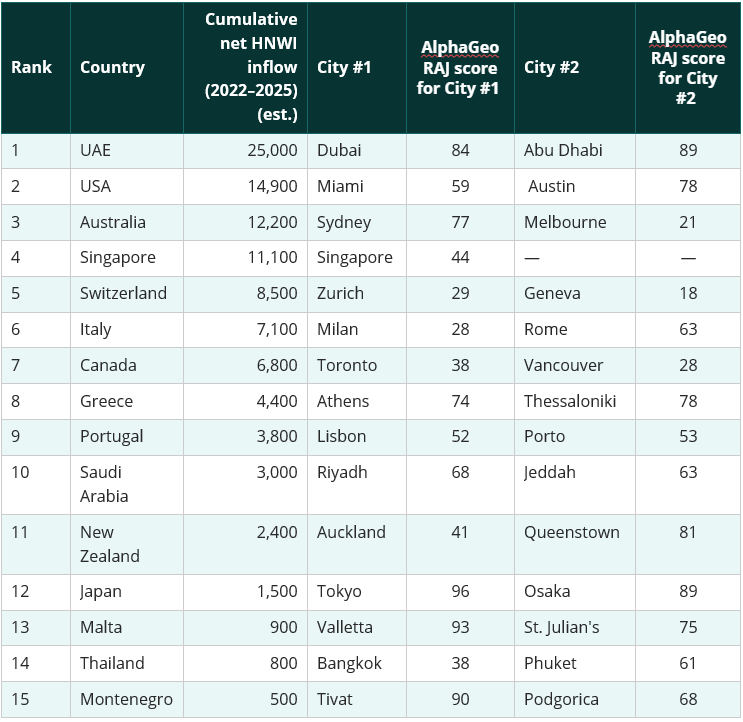
The post-pandemic migration wave has reshuffled and expanded the global wealth map. While the UAE has surged ahead of any single European country in attracting inflows, southern Europe has emerged as a new center of gravity, driven by flat-tax regimes and lifestyle appeal. Within the USA, wealth is concentrating in low-tax, high-growth metros rather than traditional hubs.
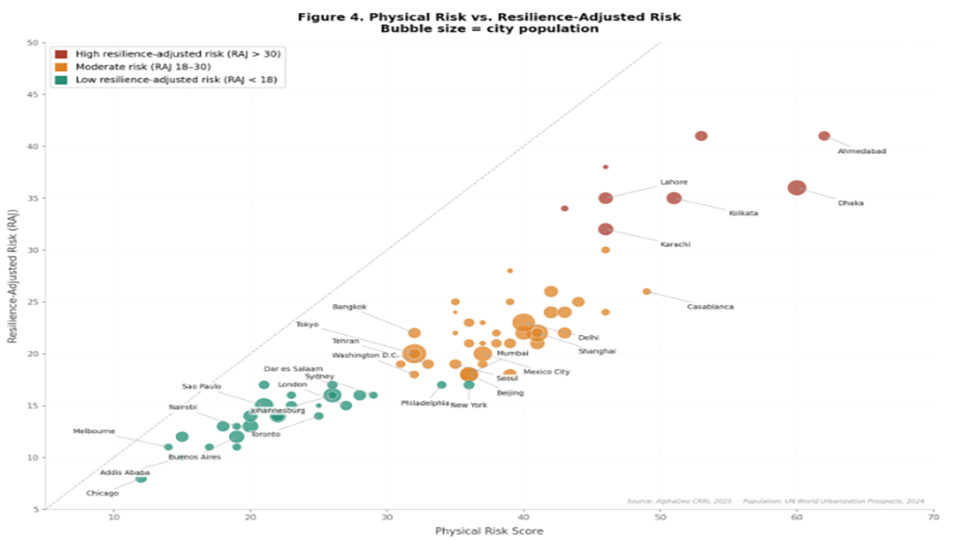
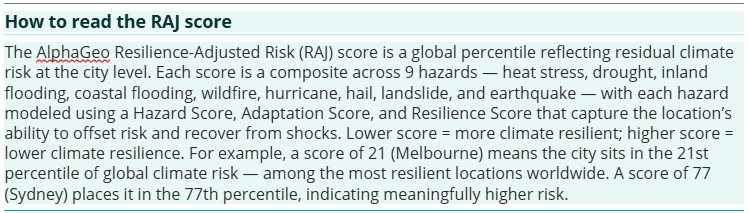
Tax efficiency and governance quality remain the headline drivers, but an additional variable is gaining weight — climate resilience – and it increasingly measurable and directly relevant to long-term asset values. Here we depict not only net inflows for key wealth hubs, but also AlphaGeo’s proprietary Resilience-adjusted Climate Risk (RAJ) score for each city. The RAJ score measures the vulnerability of a location to physical climate risks, after adjusting for local adaptations already in place.
Beyond Migration: The Urgency of Measuring Resilience
Inflow rankings show where wealth is moving – but they do not reveal whether those destinations can sustain a high quality of life over a multi-decade year investment horizon. The Resilience-Adjusted Risk (RAJ) scores in the table above begin to answer that question — operating at the city level, where the divergences are material: Melbourne scores 21, substantially better than Sydney at 77; Milan at 28 performs much better than Rome with 63; Austin (78) and Miami (59) both face challenges to enhancing their long-term resilience.
Notable Emerging Destinations
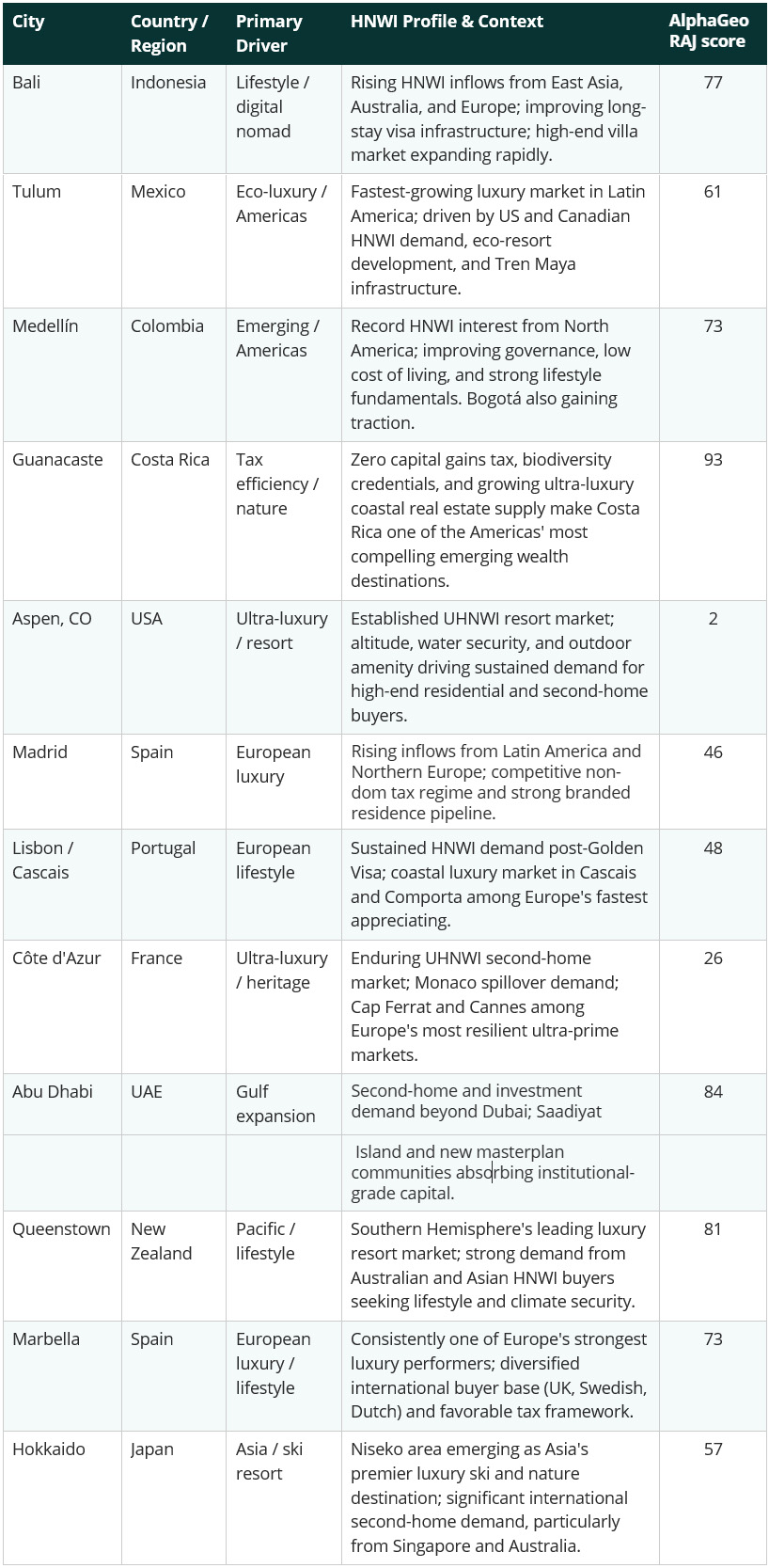
Beyond the top 15, a broader set of markets is capturing HNWI attention — not as primary residences but as second homes, lifestyle bases, and alternative wealth anchors. These destinations are shaping where the next tier of private capital is being deployed.
Beyond the Rankings: The Intelligence Layer
While AlphaGeo’s RAJ scores answer the climate resilience question, two further dimensions complete the due diligence picture for any destination on this list.
The destinations attracting wealth today are not uniformly built to hold it. Separating durable wealth centers from transient ones requires data that migration rankings alone cannot provide.
What does risk mean for asset values?
AlphaGeo’s Financial Impact Analytics (FIA) model the effect of climate volatility on the cashflow drivers that determine value: insurance cost trajectories, insurability risk, retrofit CapEx, and a climate-adjusted discount rate. These plug directly into DCF models — translating location risk into investment-grade financial metrics that family offices and investment managers can use in determining which of their current or potential future real estate assets represents the best long-term value.
Is the macro environment durable?
AlphaGeo’s Location Dynamism Signals (LDS) consolidates 60+ datasets across macroeconomic, fiscal, socioeconomic, and geopolitical domains into a single intelligence layer for any market globally — the due diligence layer that determines whether today’s migration wave reflects structural opportunity or transient policy arbitrage.
A Complete Solution for Global Residential Investment Planning
For family offices and institutional allocators tracking HNWI flows, identifying where wealth is moving is only the first question. AlphaGeo also answers the rest — from climate resilience and financial impact to the macro signals that guide real estate investing decisions.
To access our specific market-level scores and data, or to learn how AlphaGeo can support your global real estate portfolio construction, reach out to us at: [email protected]
Learn more: alphageo.ai
Sign up for a free trial: alphageo.ai/free-trial