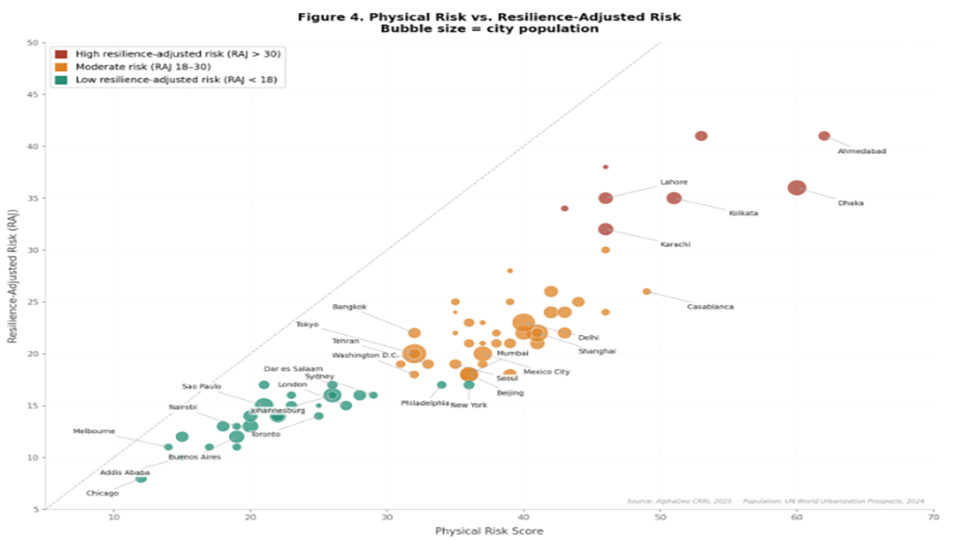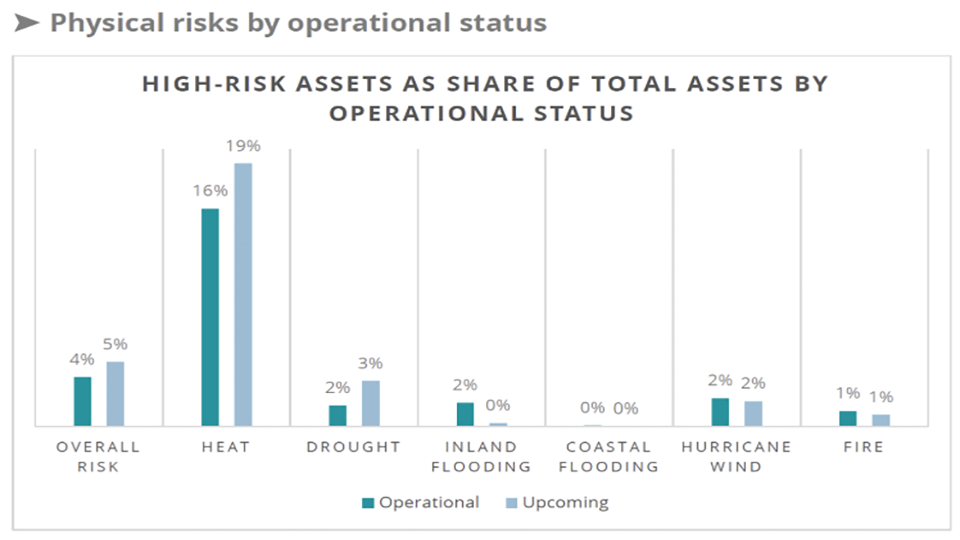
Climate change is already hitting infrastructure performance. A 2021 survey reported that 45% of US data centres had experienced an extreme weather event that threatened operations, and that nearly 90% of stakeholders believed climate change would increase data center costs over the next decade. Ports are equally vulnerable: Hurricane Florence caused $46 million in damages to US ports in 2018, while Typhoon Lekima shut down China’s Port of Dalian for five days in 2019, cutting $65 million in port income. Airports face similar risks, with London’s Luton Airport forced to suspend flights in 2022 after extreme heat warped its runways.
These tangible impacts are why we’ve expanded our Financial Impact Analytics to quantify climate’s impact on the key drivers of infrastructure value, to help investors and operators understand the financial realities of climate change.
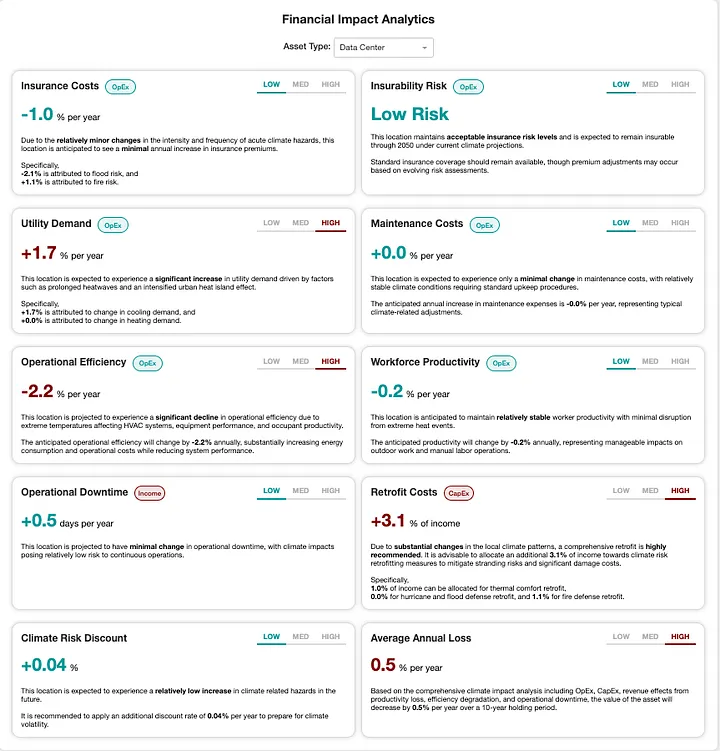
This article highlights four new metrics we consider especially relevant for infrastructure investors:
1. Operational Downtime
2. Operational Efficiency
3. Maintenance Costs
4. Workforce Productivity
Operational Downtime
Annual change in operational downtime due to risks of precipitation, fire, and water shortage
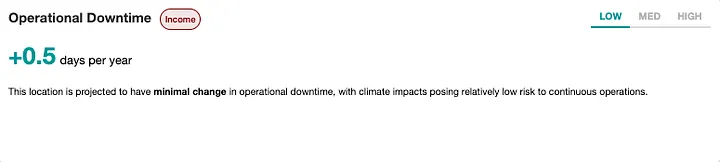
Extreme weather events increasingly disrupt continuous operations, directly affecting the bottom-line through lost revenues. Hurricane Beryl forced Texas energy infrastructure offline for days, causing $28–32 billion in regional economic losses (Reuters). For data centers where downtime averages $9,000 per minute — or $540,000 per hour — even brief climate-related outages can devastate annual returns (DatacenterDynamics).
Operational Efficiency
Annual rate of change in operational efficiency due to temperature effects on HVAC systems and equipment performance
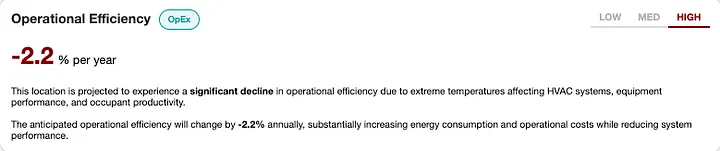
Rising temperatures can alter infrastructure performance. Data centers consume exponentially more energy as ambient temperatures rise — Microsoft analysis showed free-cooled facilities experiencing significantly higher component failure rates due to thermal stress (Microsoft Research). Industrial facilities also see efficiency losses as extreme heat reduces equipment performance.
Maintenance Cost
Projected changes in upkeep and repair costs from chronic climate conditions and extreme weather
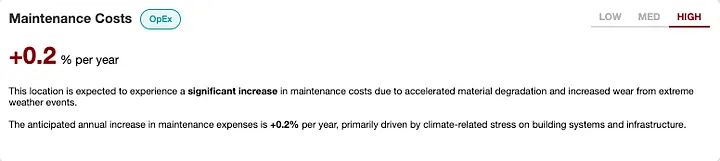
More frequent and severe environmental stressors accelerate wear and tear, which can increase maintenance costs. For instance, heat stress may cause materials like concrete and asphalt to degrade faster or HVAC systems to require more servicing; heavier rainfall and flooding can corrode pipelines and electrical systems. An example from Infrastructure Ontario has found that Ontario infrastructure faces an additional $4.1 billion annually in climate-related maintenance costs, representing a 16% increase over stable climate scenarios (Financial Accountability Office Ontario).
Workforce Productivity
Forecasted change in workforce productivity driven by extreme heat

Heat impacts don’t stop at equipment — they affect human operators too. Analysis of 2.7 million firms found that ten extra days above 35°C reduced annual labor productivity by 0.3%, with additional heatwaves causing further declines (CEPR VoxEU). For infrastructure requiring 24/7 oversight and emergency response, these losses translate directly into operational risk and cost escalation.
Learn More
AlphaGeo’s Financial Impact Analytics transform abstract risks into precise projections. Whether conducting due diligence, planning capital improvements, or modelling returns, these metrics provide the foundation for climate-informed decision making.
Ready to integrate climate reality into your financial planning?
Sign up for a free trial to explore how Financial Impact Analytics can enhance your investment analysis and strategic planning.
AlphaGeo’s Financial Impact Analytics product covers residential, commercial, utilities and transport infrastructure, airports, seaports, and data centers globally, with projections under SSP245, SSP370, and SSP585 emission scenarios.