For power system owners, operators, and investors, climate hazards are now material financial risks. As grids face new extremes, the mismatch between historical design standards and current climate realities grows wider every year. To understand these vulnerabilities at scale, our latest analysis evaluates 34,000+ power plants worldwide, assessing acute and chronic climate risks and their financial impact.
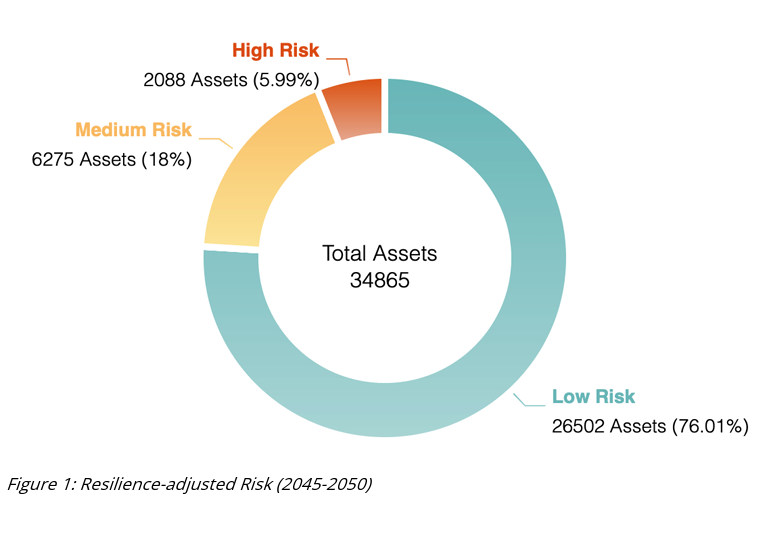
Our findings show that by mid-century, one in four global power generation assets will face medium-to-high resilience-adjusted climate risk, rising to nearly half by 2100. This escalating exposure threatens long-term earnings and asset valuation, with over 70% of assets set to face moderate-to-high increases in insurance premiums, retrofit costs, operational downtime, and efficiency losses.
1. Overall risks: By mid-century, one in four global power generation assets will face medium-to-high physical climate risks (referring to heat stress, inland and coastal flooding, drought, wildfire, and hurricane wind). This figure rises to nearly half by 2100.
- Risk by hazard type: On aggregate, global power assets are most exposed to hurricane wind, wildfire, and heat stress.
2. Risk by geography: Power infrastructure in Sub-Saharan Africa, the Middle East, and portions of South and Southeast Asia are exposed to the greatest risk, while most of North America and Western Europe are characterized by lower relative risk.
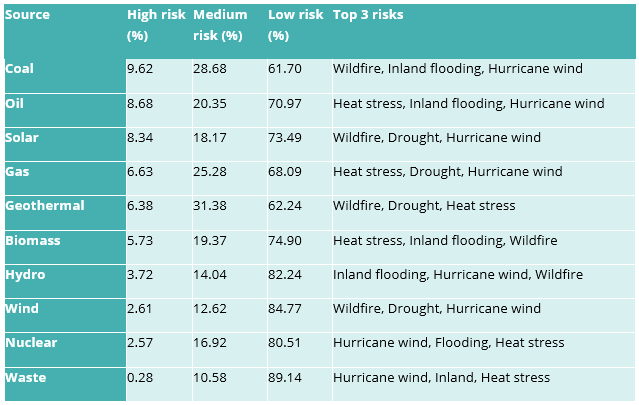
3. Risk by fuel type: Coal power plants have the highest percentage of assets classified as high risk with wildfire, inland flooding, and hurricane wind posing greatest threats. Oil and solar plants follow closely behind.
4. Financial impact: This escalating exposure threatens long-term earnings and asset valuation, with over 70% of assets set to face moderate-to-high increases in insurance premiums, retrofit costs, operational downtime, and efficiency losses
Data Sources and Methodology
Scenario and Time Horizon
This report analyzes over 34,000 power plants from the World Resources Institute’s Global Power Plant Database across six key hazard types. The analysis uses the SSP3-7.0 (Medium Emissions) scenario, projected to 2050 to approximate the expected working life of current and upcoming (planned or under construction) power plant assets.
- Heat Stress
- Drought
- Inland Flooding
- Coastal Flooding
- Hurricane Wind
- Wildfire
Methodology: Resilience-adjusted Risk
Our analysis employs AlphaGeo’s distinctive Resilience-adjusted Risk methodology, delivering a nuanced and more accurate depiction of “ground truth” risk. We measure climate risk based on a combination of (1) Physical Climate Risk; (2) Resilience adjustments based on the presence of hazard-specific adaptations in place (e.g., in the case of flood risks, these refer to adaptations such as direct flood barriers, drainage system capacity, flood control systems, and others).
Full details of our hazard modelling and scoring methodology can be found here.
Methodology: Financial Impact Analytics
AlphaGeo’s Financial Impact Analytics translate climate risk into its tangible financial impacts, addressing the “so-what” of climate risk. We model the impact of climate scenarios on annualized changes in:
- Insurance Premiums
- Utility Demand
- Retrofit Costs
- Discount Rates
- Operational Downtime
- Operational Efficiency
- Workforce Productivity
- Maintenance Cost
- Insurability Risk
These metrics cover income, OpEx, CapEx, and discount rates, and can be plugged into existing financial frameworks (e.g., discounted cashflow analyses), integrating climate risk into the underwriting or financial planning process.
Full methodological details can be found here.
Physical Risk Insights
Overall risk
A quarter of global power generation assets are exposed to medium-to-high resilience adjusted climate risk by mid-century. Risk also intensifies over asset lifetimes, affecting long-term earnings and valuation. By end-century (2100), nearly half of all power plant assets are expected to be at moderate to high risk of climate-driven hazards.
This represents a substantial share of global installed capacity at growing risk of:
- Capital impairment and stranded-asset outcomes
- Increased volatility in operational performance
- Escalating maintenance and retrofit requirements
- Higher cost of capital and insurance constraints
Physical risk by hazard type
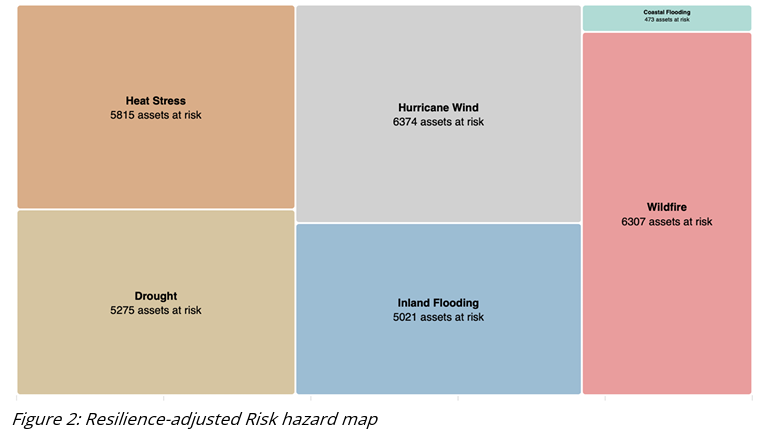
Across the 34,000+ power plants evaluated, the top climate hazards affecting asset performance are:
- Hurricane wind: 6,374 assets
- Wildfire: 6,307 assets
- Heat stress: 5,815 assets
- Drought: 5,275 assets
- Inland flooding: 5,021 assets
These are all hazards with significant operational, and consequently, financial implications for the power generation sector. Hurricane wind, for instance, damages transmission infrastructure and forces wind turbines to shut down at speeds exceeding 25 m/s, while destroying substations and transformers — as seen when Hurricane Sandy damaged 50 substations and 4,500 utility poles on Long Island. Meanwhile, wildfire causes direct asset damage, and can reduce solar PV output due to smoke interference and ash buildup on panels. Heat stress cuts efficiency across the board: thermal plants (gas, coal, nuclear) face cooling water shortages and must derate output, natural gas turbines lose up to 25% efficiency, solar panels produce less electricity as temperatures rise, and transmission lines lose up to 5.8% capacity.
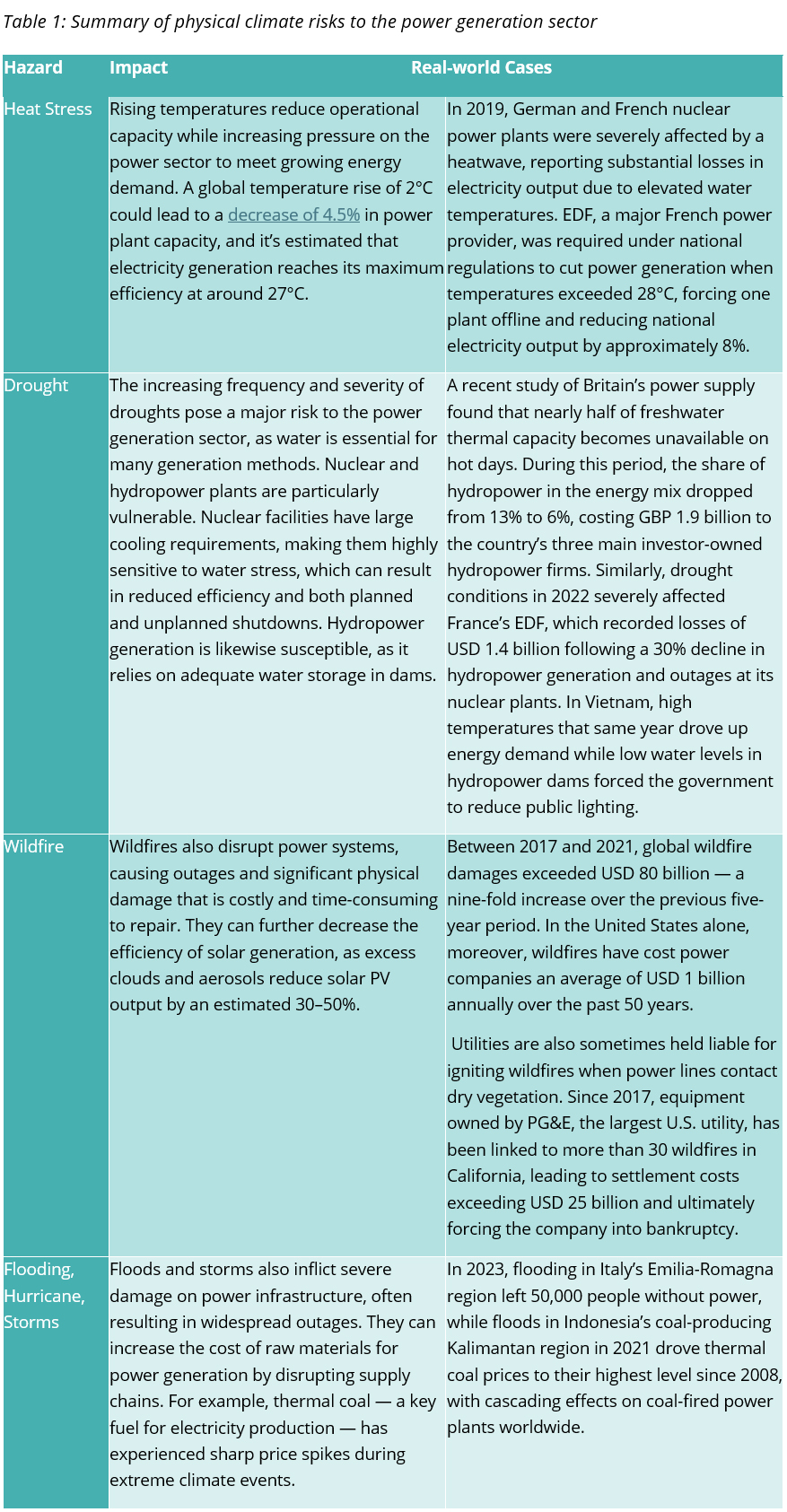
The table below summarizes the impacts of each hazard on the power generation sector, drawing on key findings from the UNEP report “Climate Risks in the Power Generation Sector”.
Physical risk by geography
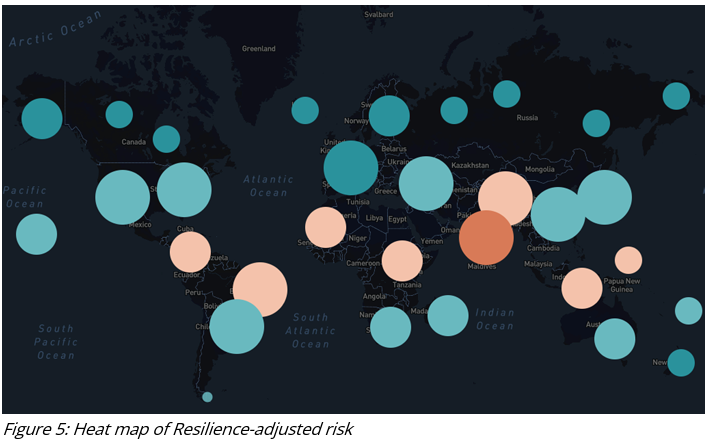
Power infrastructure in Sub-Saharan Africa, the Middle East, and portions of South and Southeast Asia are exposed to the greatest risk, while most of North America and Western Europe are characterized by lower relative risk. Most of the top-10 assets at-risk are located in Africa.
Physical risk by fuel type
Coal power plants have the highest percentage of assets classified as high risk with wildfire, inland flooding, and hurricane wind posing greatest threats. Oil and solar plants follow closely behind.
2. Financial Impact Insights
Climate impact on the bottom-line
Climate-related physical risks have become a rapidly escalating financial reality for the world’s largest energy and utility companies. On average, electric utilities face costs more than 4.6 times higher than those in other sectors. For companies in the S&P Global 1200, annual financial exposure is projected to climb from $885 billion in the 2030s to $1.2 trillion by the 2050s. Utilities and energy companies sit at the epicenter of this shift, experiencing the greatest impact, , driven by asset damage, costly retrofits, and mounting operational losses.
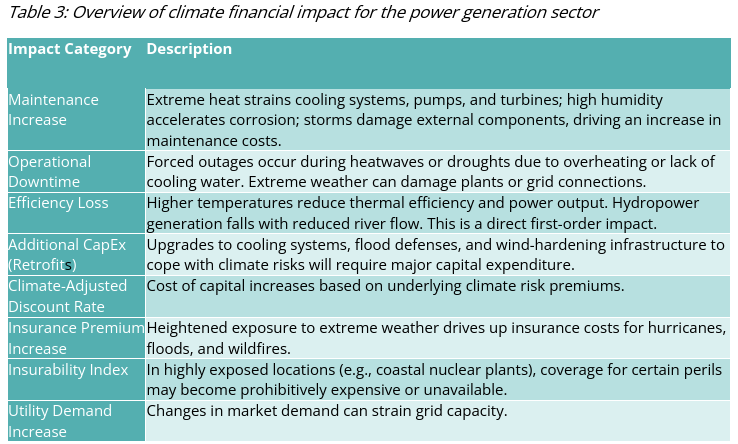
AlphaGeo’s Financial Impact Analytics are designed to quantify the direct financial effects of climate change. Our methodology assesses the specific vulnerabilities of each asset type — including power plants — to climate-related financial impacts, assigning a sensitivity coefficient that reflects the expected degree of exposure for that asset type. The financial impact metrics we model are summarized in the table below, with each metric calibrated to reflect asset-specific sensitivity to climate risks.
Financial impact assessment
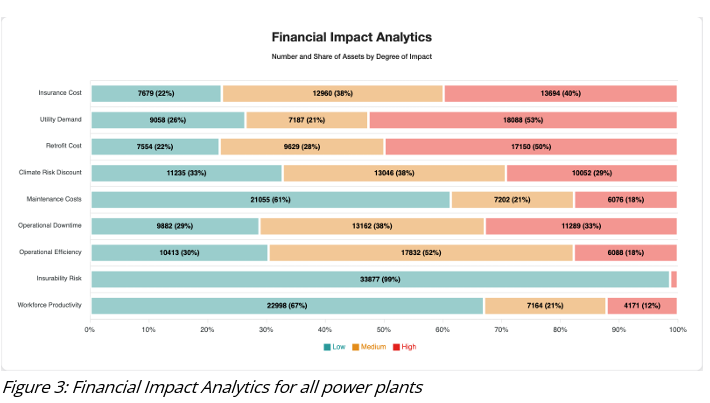
Over 70% of all assets are projected to experience moderate-to-high increases in (1) utility demand, (2) insurance costs, and (3) retrofit costs, alongside impacts on (4) operational downtime and (5) operational efficiency.
While most of these factors exert upward pressure on operating and capital expenses — ultimately constraining profitability — an increase in utility demand can represent a positive signal if effectively managed. Higher utility demand in the plant’s vicinity indicates rising electricity needs in the surrounding area, implying greater capacity utilization and potential revenue or profitability gains. This, in turn, may signal opportunities for capacity expansion or new builds supported by sustained demand growth. However, if poorly managed or if coupled with heat stress effects on power plant efficiency, disruptions in power generation can also occur, due to supply and demand dislocation as heat causes demand for electricity to rise, but also disrupts supply from power plants. Careful planning by operators is required to manage this dilemma.
While most of these factors place upward pressure on operating and capital expenditures — ultimately constraining profitability — an increase in utility demand can signal a positive opportunity if effectively managed with advanced planning. Rising electricity demand in a plant’s vicinity signals stronger local consumption, implying higher capacity utilization and potential gains in revenue and profitability. This trend may also indicate opportunities for capacity expansion or new builds supported by sustained demand growth.
However, if not properly managed — or if combined with heat stress that reduces plant efficiency — this same dynamic can lead to severe disruptions. As heat drives electricity demand upward while simultaneously impairing generation capacity, supply–demand imbalances can emerge. These patterns were observed during a European heatwave in 2022, when German power plant productivity declined during the heatwave, while energy demand rose. Coupled with decreased gas supply from Russia, this contributed to energy prices in Germany reaching an all-time high. Careful planning and adaptive operational strategies are therefore essential to navigate this challenge.
Conclusion
Climate risks have become a defining challenge for the global power sector, with both acute hazards and chronic stresses translating into significant, tangible financial and operational impacts worldwide. A growing body of real-world evidence demonstrates that these impacts are no longer theoretical but an accelerating reality. To safeguard value, manage rising costs, and ensure long-term system reliability, utilities, operators, and investors must integrate climate risk analytics and resilience frameworks directly into asset planning and investment strategy.
Learn more
To learn more about our products and services, visit alphageo.ai or reach out to us at info@alphageo.ai. A free trial can also be accessed at app.alphageo.ai/trial_setup.