India’s commercial real estate sector is undergoing rapid expansion, fueled by urbanization, foreign investment, and the rise of global capability centers. Yet, this momentum faces a defining challenge: climate change’s accelerating impacts on investment performance, tenant demand, and long-term asset value.
AlphaGeo’s latest report provides a systematic assessment of physical climate risks across India’s leading office markets. We partnered with Propstack, combining our climate analytics with Propstack’s transaction-level leasing data from major real estate investment trusts (REITs) — Brookfield, Mindspace, Embassy, and Knowledge Realty Trust.
Our findings show that slightly over 40% of all REIT assets analyzed have medium-to-high exposure to physical climate hazards, with heat stress, drought, and wildfire posing the largest risks. This is expected to result in significant financial impact, with over 90% of assets expected to see a medium-to-high increase in insurance premiums, retrofit costs, and discount rates due to elevated risks.

Data Sources
- Climate Analytics (AlphaGeo): Physical climate risk scores across six hazards, adjusted for resilience features like green cover, flood defense, emergency infrastructure, and climate-adaptive design.
- Transaction Data (Propstack): Over 5,000 lease records — including building size, lease terms, tenant sectors, and locations — for assets in Gurgaon, Kolkata, Noida, Delhi, Mumbai, Pune, Bangalore.
Methodology: Climate Risk
We assessed REIT assets (Brookfield, Mindspace, Knowledge Realty Trust and Embassy) for climate risk across the following parameters:
- Hazard types: Heat Stress, Drought, Inland Flooding, Coastal Flooding, Hurricane Wind, Wildfires
- Scenario (unless otherwise stated): SSP3-7.0
Our analysis employs AlphaGeo’s distinctive Resilience-adjusted Risk methodology, delivering a nuanced and more accurate depiction of “ground truth” risk. This means that our climate risk scores are a combination of (1) Physical Climate Risk; (2) Resilience adjustments based on the presence of hazard-specific adaptations in place (e.g., in the case of flood risks, these refer to adaptations such as direct flood barriers, drainage system capacity, flood control systems, and others).
All scores are modelled at the city-level, with asset-level data available on request. Full details of our hazard modelling and scoring methodology can be found here.
Methodology: Financial Impact Analytics
AlphaGeo’s Financial Impact Analytics translate climate risk into its tangible financial impacts, addressing the “so-what” of climate risk. We model the impact of climate scenarios on annualized changes in:
- Insurance Premiums
- Utility Demand
- Retrofit Costs
- Discount Rates
- Operational Downtime
- Operational Efficiency
- Workforce Productivity
- Maintenance Cost
- Insurability Risk
These metrics cover income, OpEx, CapEx, and discount rates, and can be plugged into existing financial frameworks (e.g., discounted cashflow analyses), integrating climate risk into the underwriting or financial planning process.
Full methodological details can be found here.
1. Overall Results
Physical Climate Risk by Hazard Type
As a whole, Indian REITs are most exposed to heat stress, followed by drought and wildfire.
Summary Table of REIT Asset Risk by Hazard Type (Mid-century: 2045-2050)
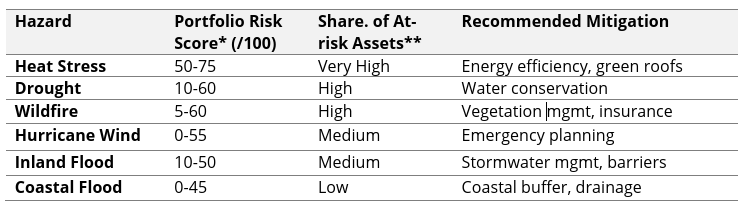
*Score range for REIT assets analyzed.
**At-risk assets refer to assets with medium-to-high risks.
This is particularly the case for assets in Chennai, Noida, Delhi, Gurgaon and Mumbai, which show consistently high heat stress driven by rising annual maximum temperatures and limited urban greenery. In addition, the share of assets at-risk of inland and coastal flooding increases significantly by endcentury, with a third of REIT assets forecast to be at medium-or-high risk.

Climate Financial Impact
Physical climate risk scores only tell one part of the story. AlphaGeo’s Financial Impact Analytics translate acute and chronic risks into its likely financial impacts.
Projected annual changes for climate-driven costs are as follows:
- Insurance Cost Increases: Likely substantial for flood- and heat-prone assets by 2050 and beyond.
- Utility Demand Growth: Strong correlation with an increase heat stress; assets may see a 0.2% to 0.4% annual increase in cooling energy demand for affected assets.
- Retrofit Costs: Major upgrades needed for flood barriers, cooling infrastructure, and energy efficiency especially for assets with risk scores above 70.
- Climate Risk Discount: Future asset pricing will increasingly reflect resilience, with discounts or premiums tied to local adaptation measures.
Results by Sector and Location
- IT/BPO & Commercial: Most exposed to productivity loss and operational cost spikes due to heat stress, especially in Gurgaon, Noida, and Bangalore.
- BFSI/Healthcare: Exposed to flooding hazards due to regulatory and operational dependencies by end-century. Coastal assets (Mumbai, Kolkata) will need enhanced drainage and coastal defences.
- Consulting/Other: Less directly exposed, but vulnerable to indirect business continuity risk and insurability.
2. Climate Risk and Financial Impact by City
Mumbai
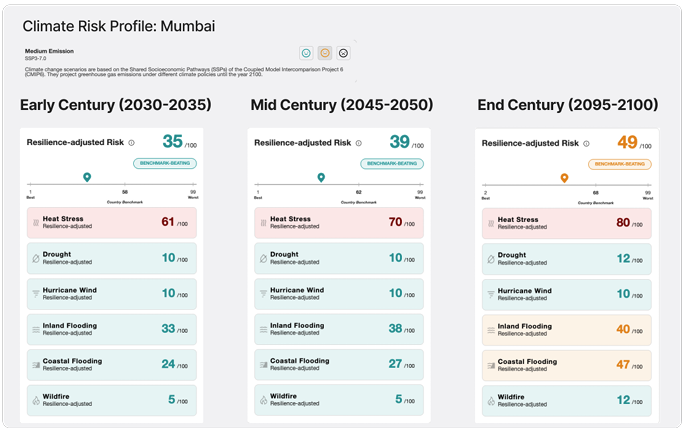
- Heat Stress: Very high and rising with days above 35°C increasing to 83 per year.
- Flooding: Flood risks escalate from low to moderate risks by end-century, driven rising sea levels. Urban and stormwater management become critical for resilience.
Pune
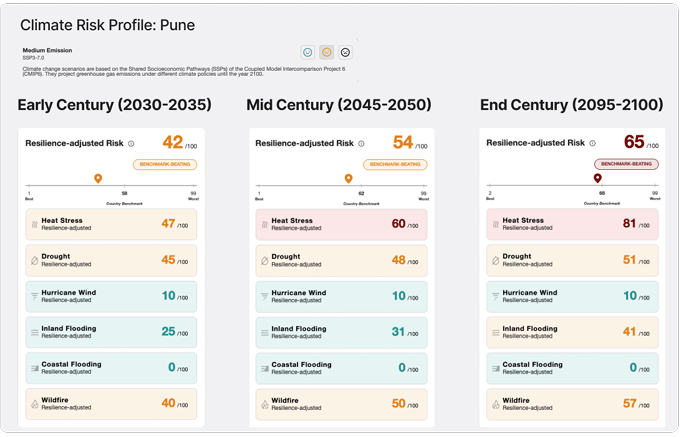
- Heat Stress: High risk with annual maximum temperatures consistently > 40°C, CDD increasing and days above 35°C rising to over 220 days by end century.
- Drought: Medium. Long consecutive dry periods and high water demand ratios indicate structural water risk.
- Inland flooding: Risk increases by end-century, necessitating upgraded drainage and early warning systems. Opportunity to strengthen adaptive capacity for flood in Pune – amongst them presence and coverage of direct flood barriers, drainage systems, and nature-based flood defenses.
- Wildfire: Moderate risk by end-century, with burnable fuel percentage approximately 33% in the region. Presence of fire detection infrastructure and fire prevention measures lacking.
Bangalore
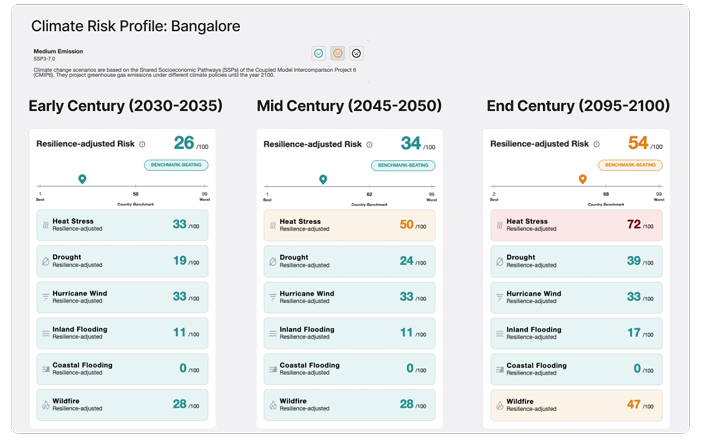
- Heat Stress: Elevated and increasing. Green infrastructure implementation is recommended.
- Wildfire: Medium risk by end-century, with potential for increased damage due to projected heat waves and urban expansion.
Hyderabad
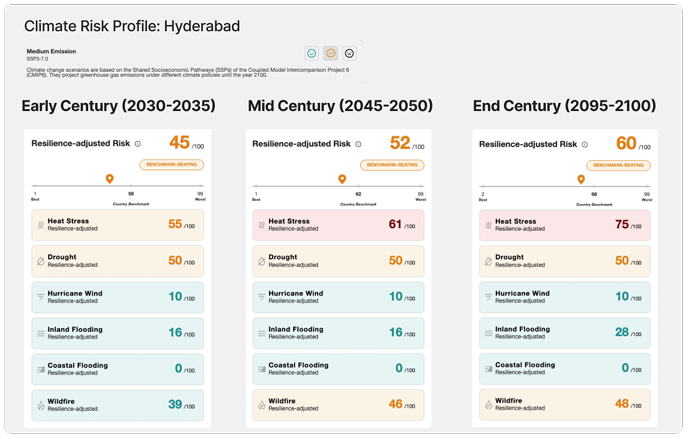
- Heat Stress: Similar to other southern cities, seeing rising extreme heat Preventive adaptation (passive cooling, water harvesting) is critical.
- Drought and wildfire: Moderate risks extending to end-century; investments in fire prevention and fire detection measures will enhance preparedness.
Delhi
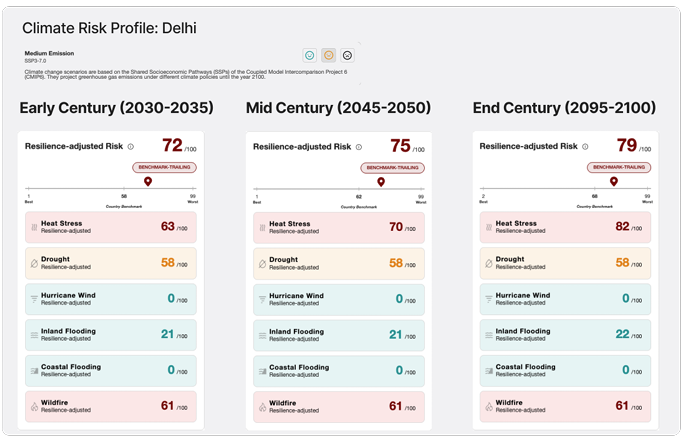
- Heat Stress: Extreme, projected annual temperatures of over 48°C, and over 200 days above 35°C by end-century.
- Drought: Medium, but urban water stress from high population growth amplifies risks through the century.
- Wildfire: High wildfire risks, driven the number of hot days. Wildfire adaptations are weak – with limited fire prevention and detection measures.
Gurgaon
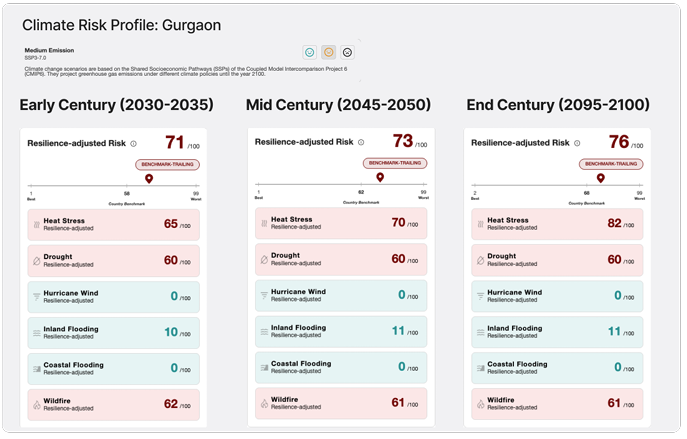
- Heat Stress: High and rising risk, following Delhi’s pattern. Urban expansion increases vulnerability; passive cooling and efficiency upgrades are vital.
- Drought: High. Asset owners should focus on water reuse and stakeholder engagement.
- Wildfire: High exposure to wildfire risks, and resilience measures such as fire detection infrastructure should be proactively adopted.
Noida
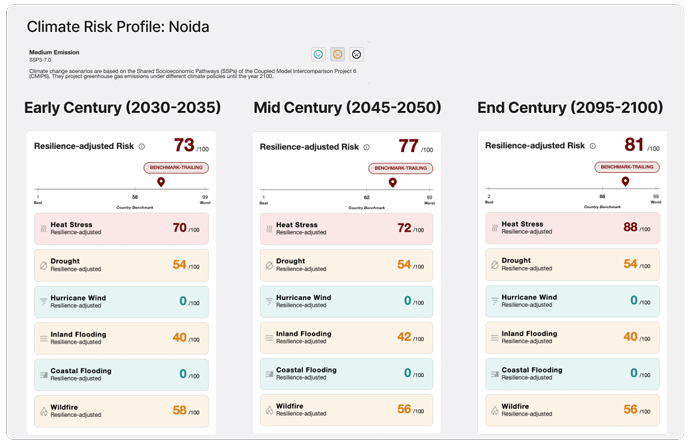
- Heat stress: High with temperatures of up to 48°C by end-century.
- Drought: Moderate risks; increase drought readiness by improve access to emergency water access
- Flooding: Moderate risks with poor preparedness in terms of the presence of direct flood barriers.
- Wildfire: Moderate risks over time; like the rest of India, potential to improve presence of fire prevention and detection measures
Kolkata
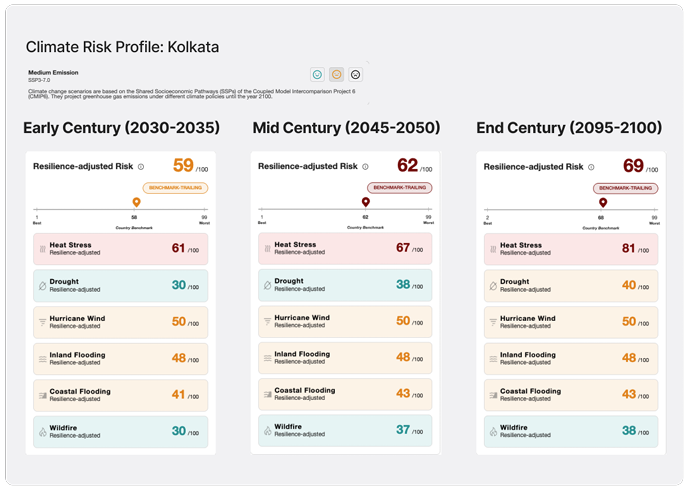
- Heat Stress: Very high, days above 35°C increasing sharply.
- Drought: Medium risk, driven by temperature increases.
- Flooding: Moderate risks for both inland and coastal flooding, with increases in inundation depths predicted. In urban areas, direct flood barriers and drainage systems are recommended. For both inland and coastal flooding, nature-based flood defenses (mangroves, wetlands) are recommended.
City-wise Analysis: Summary of Physical Risk Exposure
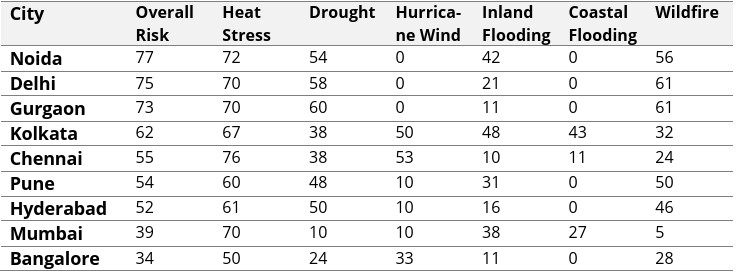
Comparative City Climate Risk Table (Mid Century: 2045-2050)
Key Takeaways for Asset Managers
- Heat stress is consistently the strongest and most widespread hazard across cities (Chennai 76, Noida 72, Delhi/Gurgaon/Mumbai 70).
- Drought pressures are highest in Gurgaon (60), followed by Delhi (58) and Noida (54).
- Inland flooding is most acute in Kolkata (48), Noida (42), and Mumbai (38).
- Coastal flooding stands out for Kolkata (43) and Mumbai (27).
- Wildfire risk is elevated in Delhi and Gurgaon (61 each), Noida (56), and Pune (50).
- Overall risk is highest in Noida (77), Delhi (75), and Gurgaon (73), making the NCR the most exposed cluster.
- Lowest overall risk is observed in Bangalore (34), with moderate exposure to heat (50) and some wind (33).
Recommendations
- Prioritize energy efficiency and green infrastructure in all new and existing buildings, especially in Chennai, Noida, Delhi, Gurgaon, Mumbai.
- Invest in water conservation, alternate water sourcing (recycled, rainwater harvesting), and integrate drought resilience planning in asset operations.
- In coastal and flood-prone cities (Kolkata, Noida, Mumbai), strengthen coastal defenses, expand flood buffers, and upgrade drainage systems.
- Work with local authorities for multi-stakeholder resilience, focusing on emergency preparedness, community engagement, and regulatory compliance.
City-wise Analysis: Summary of Financial Impact
The financial impact due to climate risks across all buildings and cities — Mumbai, Pune, Bangalore, Hyderabad, Delhi, Gurgaon, Noida, and Kolkata — can be synthesized based on key metrics from multi-asset climate risk reports. Impacts are projected under a medium emission scenario (SSP3-7.0), up to 2050, and affect insurance costs, utility demand, retrofit costs, climate discount, maintenance costs, operational downtime, efficiency, insurability risk, and workforce productivity.
General Trends
All figures are annualized.
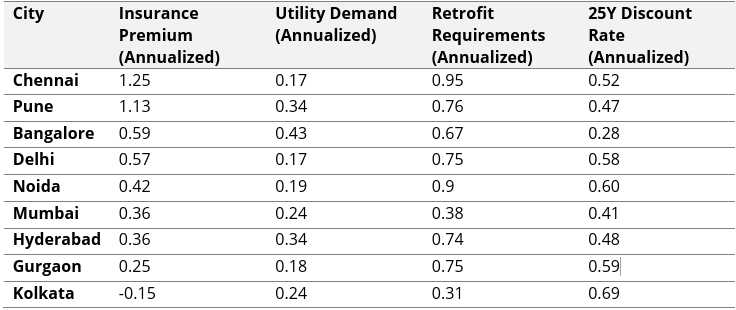
- Insurance Costs: Mostly rising, spanning −0.15% to +1.25% annually. Chennai (+1.25%) and Pune (+1.13%) lead the increases; Kolkata (−0.15%) shows a decline.
- Utility Demand: Heat-driven demand increases in every city, +0.17% to +0.43% annually. Bangalore (+0.43%) is highest, with Pune/Hyderabad (+0.34%) elevated; Chennai/Delhi (+0.17%) are lowest.
- Retrofit Requirements: Adaptation spend is material across markets, +0.31% to +0.95% annually. Chennai (+0.95%) and Noida (+0.90%) are most exposed; Kolkata (+0.31%) and Mumbai (+0.38%) are lighter.
- 25Y Climate Discount Rate: Higher rates across the board, +0.28% to +0.69% annually. Highest in Kolkata (+0.69%), Noida (+0.60%), Gurgaon (+0.59%), Delhi (+0.58%); lowest in Bangalore (+0.28%).
Detailed Table: Impact by City (Mid-century: 2045-2050)
Sector-specific Effects
- Information Technology & Services: High heat stress drives cooling and energy retrofits; insurance increases remain minor unless flood exposure increases.
- Healthcare & BFSI: High insurance sensitivity to utility disruptions; high value assets in Gurgaon, Delhi, Mumbai vulnerable to operational downtime, especially during summer peaks.
- Engineering & Manufacturing: Retrofit costs higher if sites exposed to inland flooding, but overall financial impact remains modest.
- Consumer & Retail: Marginal increases in operational and retrofit costs; climate discount more pronounced for assets in heat/flood-prone micro markets.
Key Takeaways for Asset Managers
- Retrofit costs and utility expenditure are the largest annualized contributors, especially in high heat and flood exposure cities like Bangalore, Chennai.
- Insurance cost increases are <1% annualized per building, but cumulative portfolio risk grows as extreme events escalate through the century.
- Climate discounts indicate reduced future valuations and cash flows, calling for climate resilience investments and adaptation planning.
- Operational downtime and insurability risk are higher for coastal and flood-prone assets, particularly in Kolkata.
- Workforce productivity losses are predicted to be moderate at the portfolio scale but may spike for vulnerable asset clusters during heatwave and flooding events.
3. Climate Risk and Financial Impact by REIT Portfolio
This section focuses on the climate risk and financial impact exposure of assets across the Embassy REIT, Brookfield, Knowledge Realty Trust, and Mindspace REIT portfolios. Risks were modelled at the city-level.
REIT Analysis: Overall Exposure
Chart of Physical Climate Risk Across REITs (Mid-century: 2045-2050)
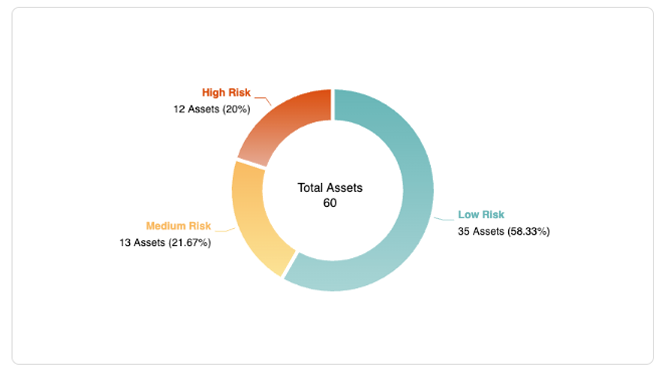
Overall, we find that over 40% of REIT assets analyzed face medium-to-high exposure to physical climate risks by 2050. Heat stress is the climate hazard with the medium-to-high exposure across all REIT assets, followed by drought, wildfire, and inland flooding.
REIT Analysis: Physical Risk by Hazard Type
Each REIT portfolio displays unique risk profiles, evaluated on resilience-adjusted risk scores across six hazard types — heat stress, hurricane wind, drought, inland flooding, coastal flooding, and wildfire. These scores reflect both physical risk and local adaptation measures.
Highest-Risk Climate Scenarios
- Heat Stress:
- Heat stress is the most significant risk for all REITs with medium-tohigh risks across most assets.
- Extreme heat and prolonged heatwaves significantly raise operational costs, utility demand, and threaten tenant productivity. Resilience-adjusted risk scores for heat stress rise to “very high” levels, impacting most urban and dense business districts.
- The financial impact includes rising energy expenses, higher insurance premiums, and depreciated asset values due to increased capital needed for cooling and adaptation.
- Drought and Wildfire:
- Moderate long-term risk.
- Hurricane Wind:
- Moderate exposure for REIT assets in Chennai and Kolkata.
- Inland and Coastal Flooding:
- Moderate exposure for REIT assets, especially in Kolkata and Noida. Frequent and intense precipitation increases flash flooding risk. Buildings in urban clusters and proximity to riverine systems face rising scores, leading to more frequent and severe disruptions, insurance costs, and expensive retrofits.
Table: Hazard Impact on REIT Assets
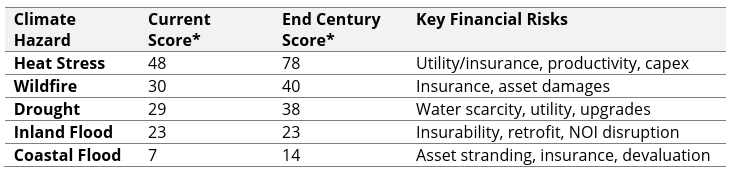
*Scores represent the average score across all REIT assets analyzed.
REITs with portfolios concentrated in high-risk geographies or lacking resilience features are most exposed to these climate scenarios, potentially leading to higher discount rates, increased cost projections, and impaired asset valuations over time.
Sample Asset Comparison Table (Mid-century: 2045-2050)
Scores are out of 100.
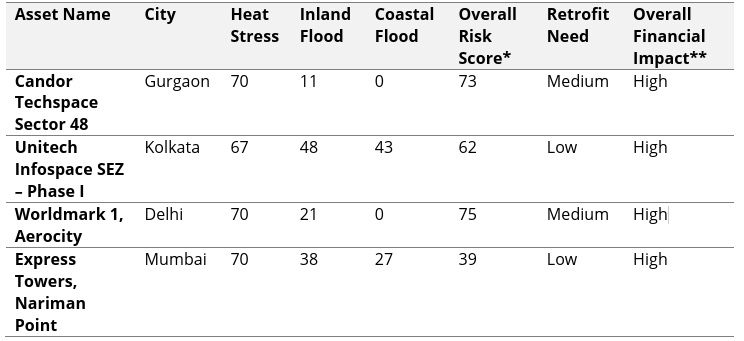
*Also includes scores for Drought, Hurricane Wind, and Wildfire, in addition to Heat Stress, Inland Flooding, and Coastal Flooding.
**Average annual loss based on comprehensive climate impact analysis including OpEx, CapEx, and revenue effects from increased utility demand, insurance costs, and discount rates.
REIT Analysis: Climate Financial Impact
The projected financial impact of climate hazards on REIT portfolios is multifaceted, affecting insurance costs, utility demand, retrofit expenditure, discount rates, and overall operational efficiency.
The cumulative impact is an increase in operational and capital costs, reduced asset values, and more volatile cash flows for REIT portfolios. Mitigation strategies — such as sustainable upgrades, insurance diversification, and proactive climate adaptation — are necessary to protect long-term returns. Climate risk scores have a direct and significant influence on REIT investment decisions, guiding portfolio allocation, asset selection, and risk management priorities.
Sample Financial Impact Analysis for Commercial Asset in Delhi
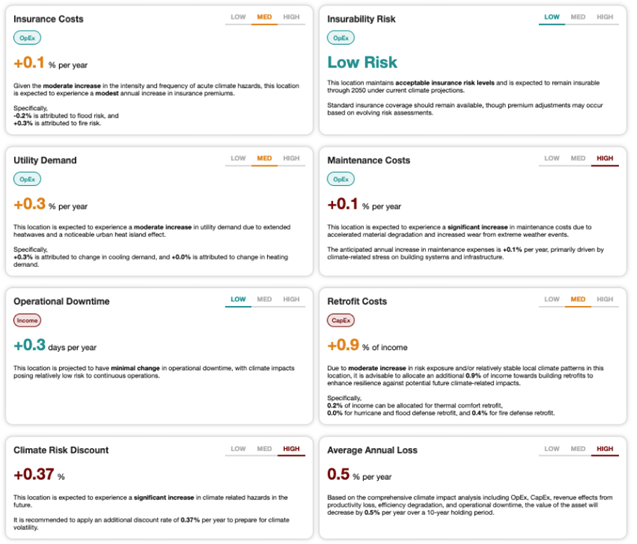
Summary Table of Financial Impact (Mid-century: 2045-2050)
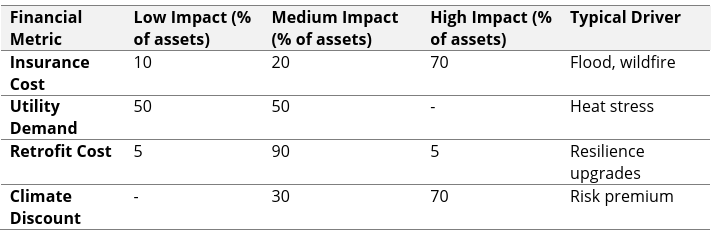
Projected climate-driven annual changes indicate substantial variations in insurance costs, utility demand, and retrofit costs:
- Insurance Costs: For Embassy and Mindspace, ~85% of assets are categorized as high impact for insurance cost. Brookfield has fewer high-impact assets presently, but future decades indicate a broader spread due to increased flooding and heat.
- Utility Demand: Extreme heat leads to increment in operational energy costs for all portfolios, with half of all assets experiencing moderate increases.
- Retrofit & Discount Rates: Retrofit expenditure is estimated to increase significantly in some urban assets by 2050 (up to nearly 1% annualized, from 2025 to 2050), leading to increased discount rates and potential asset value erosion, especially in high-risk geographies.
Insurance Costs
Climate hazards such as heat stress, flooding, and wildfires raise insurance risks, which increases annual insurance premiums and can make some assets less insurable. Across Embassy REIT, Brookfield, Mindspace and Knowledge Realty Trust portfolios, over 90% of assets are projected to experience medium-to-high insurance cost impact by 2050, reflecting increased weather-related claims and the risk of policy exclusions.
Utility Demand
Extreme heat drives up operational energy consumption and utility costs. Half of all assets are forecasted to experience medium increases in energy demand — especially due to cooling needs, resulting in higher monthly operational expenses.
Retrofit Costs
Climate changes necessitate physical upgrades or retrofits to buildings to maintain resilience against hazards. For several REIT holdings, retrofit expenditure could increase significantly within the next two decades, particularly in regions exposed to fire, flooding, or extreme precipitation events.
Discount Rates and Asset Value
Climate risk-adjusted discount rates are expected to rise for assets in high-risk geographies, reflecting increased uncertainty and potential losses. This can directly erode asset valuations and portfolio returns, as buyers and investors demand higher yields to offset additional risk.
REIT Analysis: Key Implications
Impact on Asset Selection
- Assets with high climate risk scores (for hazards such as heat stress, drought, flooding, or wildfire) become less attractive for long-term investment due to anticipated increases in insurance premiums, retrofit costs, operational downtime, and reduced insurability.
- REITs should prioritize properties with lower resilience-adjusted risk scores, favoring assets that demonstrate robust adaptation features or are in less hazard-prone regions.
Portfolio Strategy
- REITs often diversify holdings geographically and by asset class to mitigate overall portfolio exposure to specific climate hazards. For example, urban and coastal assets with higher flood risk might be balanced with inland properties with lower exposure.
- Investment strategies increasingly require integration of climate risk analytics, with scenario modeling influencing acquisition, disposition, and capital allocation decisions.
Underwriting and Valuation Adjustments
- Climate risk scores could lead to higher discount rates for high-risk assets; anticipated future losses or needed upgrades could diminish present value and limit asset pricing.
- Lenders and investors might demand additional due diligence and resilience measures for assets with elevated risk scores, affecting deal timelines and covenants.
Proactive Risk Management
- Decisions about upgrades or retrofits will be increasingly influenced by climate risk exposures; assets scored as medium-to-high risk are prioritized for resilience investments, impacting maintenance budgets and asset lifecycle plans.
- Climate risk analysis can help REITs to engage with local authorities, insurance providers, and industry partners to develop adaptation strategies, safeguard asset value, and reduce risk exposure.
Table: Influence on Investment Decisions
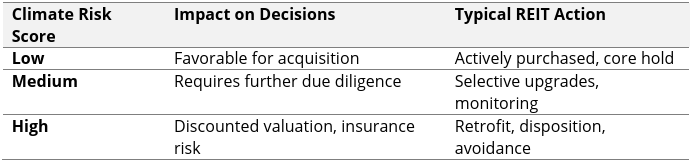
REITs with integrated climate risk score analytics make more informed decisions on which assets to buy, hold, upgrade, or sell, with portfolio resilience and long-term financial stability as key criteria.