Summary
Climate change is driving the largest internal migration in American history. Over 3.2 million Americans have been displaced by floods since 2022 alone, with $1.5 trillion in property losses on the horizon.
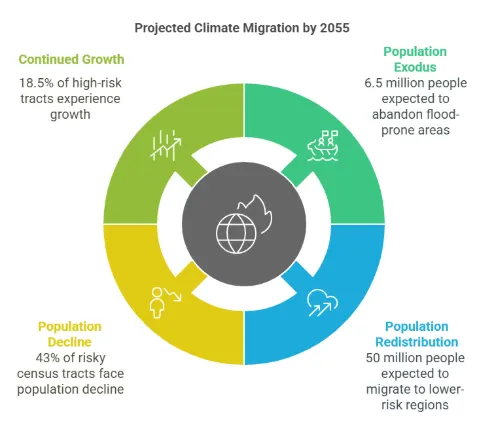
But our research reveals that climate migration is not just about escaping risk — it is about finding the right balance between safety, opportunity, and affordability. Our latest report on climate migration in the United States reveals that by 2055, approximately 6.5 million people will leave flood-prone areas while 50 million more will settle in safer regions. Yet surprisingly, nearly 1 in 5 high-risk areas will still see population growth — driven by jobs, affordability, and local adaptation efforts.
Introduction
Climate volatility is forcing Americans to move in record numbers, with 3.2 million people displaced by flood disasters since 2022. This trend has profoundly impacted the real estate industry. An estimated 22 million properties currently face some level of flood exposure, a figure that will rise by several million more in the coming decades. This paradigm shift in population redistribution is set to reshape socioeconomic patterns, strain real estate markets, and challenge infrastructure. It highlights the urgent need to anticipate future migration to enhance national preparedness and societal well-being.
To that end, AlphaGeo has conducted an in-depth study to forecast migration and settlement patterns over the next 30 years in the U.S., identifying locations that are likely to become climate havens — low risk but also offering quality infrastructure and economic opportunity.
The findings reveal that climate migration is inevitable, with significant population shifts anticipated nationwide. For example, rising flood exposure intensifying could lead to population decline in an estimated 43% of flood-exposed census tracts. This translates to approximately 6.5 million people leaving homes situated in high-risk
areas for safer regions–adding to the projected 50 million additional residents expected in safer areas by 2055.
Environmental risks are not the only drivers of migration, however. Despite flood exposure, 18.5% of high-risk census tracts are projected to see population growth by 2055, owing to economic opportunities, affordability, and other factors that outweigh flood risk in those areas. In this article, we outline a methodology to capture the additional population change expected across America’s census tracts due to climate migration and profile-contrasting behavioral patterns stemming from various combinations of climate risk and economic factors.
The Climate Consequence Metric
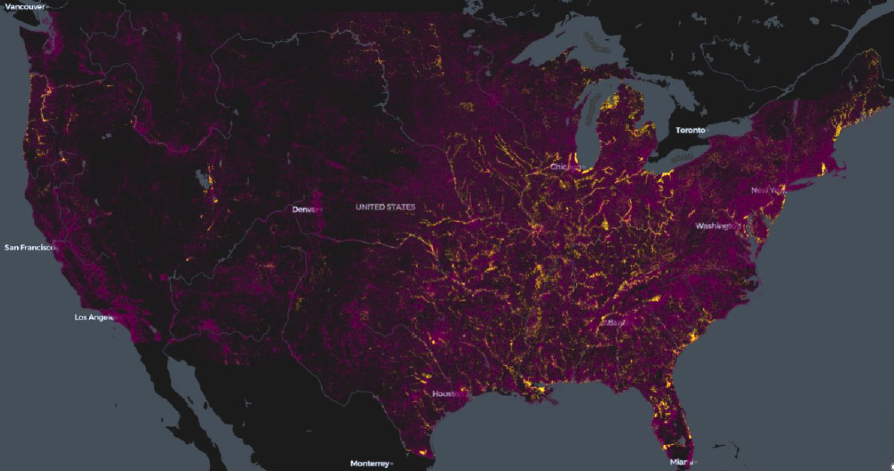
To estimate migration in a manner that integrates flood risk factors, AlphaGeo has developed climate-adjusted population projections (under the climate emissions pathway SSP245) based on historical flood impacts — both coastal and riverine — alongside key migration drivers such as employment rates, income levels, and home valuations. By analyzing historical flood data, a clear association was established between flood exposure and population trends, revealing that areas with higher historical flood exposure are more likely to experience population declines — a pattern that can be extrapolated into future projections. Using historically derived, climate-informed estimates, these factors were applied to population projections to evaluate the impact of floods on migration. This methodology provides a robust framework for understanding how flood risks will shape future demographic shifts.
Our “Climate Consequence Metric” is calculated as the difference between baseline population change forecasts and those generated with a climate correction. This metric identifies regions where flood conditions are projected to significantly alter demographic trends. By integrating Climate Consequence into future population data, we found that areas with high flood exposure show predominantly negative population growth. Map #1 illustrates the Climate Consequence Metric by highlighting locations where reduced population growth is directly linked to elevated flood exposure.
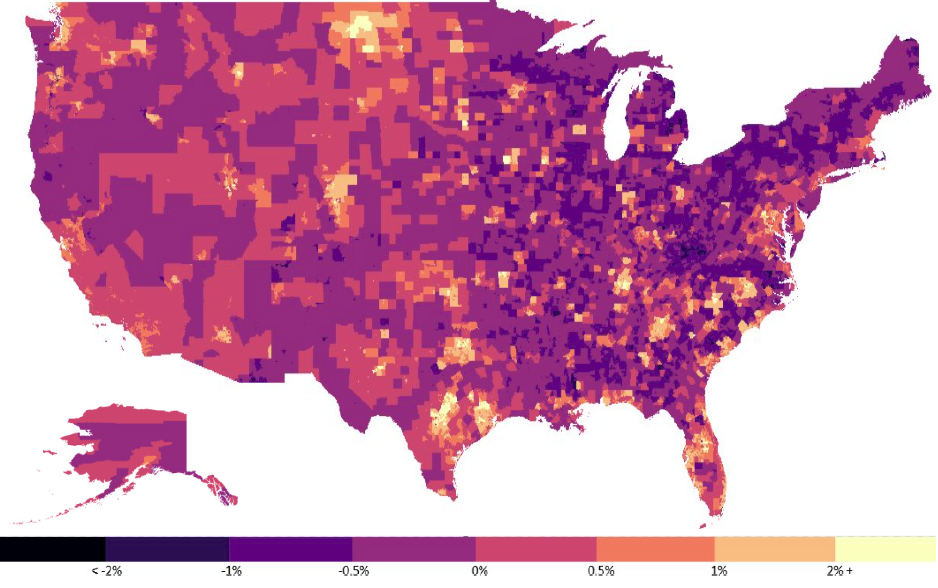
Because population shifts are more pronounced and observable at localized levels, we analyzed future flood displacement for each affected census tract. Map #2 illustrates the spatial distribution of climate-corrected future population changes, expressed as a percentage, highlighting areas most vulnerable to flood-induced displacement as well as likely population growth.
Across America’s vast geography, migration patterns emerge from various combinations of location risk and resilience, urban and suburban relocation trends, affordability and socioeconomic factors, public and private investment patterns, and climate adaptation efforts. Many population groups seek safety in lower-risk regions while others prioritize economic opportunities in high-risk areas.
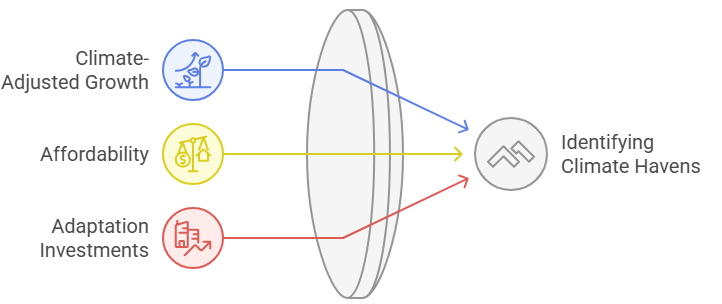
Risk-seeking States
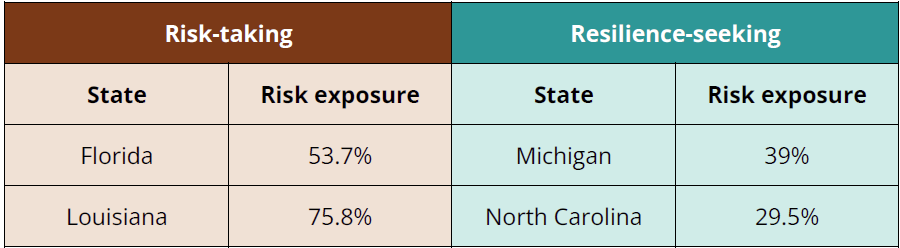
Florida is one of the most flood-prone states, with 53.6% of its census tracts exposed to flood risk. Despite this, population growth trends reveal a surprising pattern. Risky areas are experiencing higher growth compared to non-risky areas. The flood-prone regions include major coastal economic hubs that serve as centers of opportunity, infrastructure, and lifestyle amenities, potentially attracting more people to risky areas. This trend of prioritizing economic opportunities and amenities may persist over the coming decades, with certain risky areas witnessing sustained population growth.
Another key factor observed in Florida is affordability. The inverse correlation between top population-growing regions and economic factors indicates that people are increasingly moving to less dynamic but more affordable areas. Wealthy, high-resilience regions, often already densely populated and expensive, are experiencing slower growth due to rising housing costs and gentrification which displaces lower-income households. As a result, residents are shifting from expensive urban cores to more affordable suburban or exurban neighborhoods where the cost of living is lower. This affordability-driven migration is reshaping Florida’s demographic landscape with population growth expected to concentrate in emerging, less dynamic but economically accessible areas.
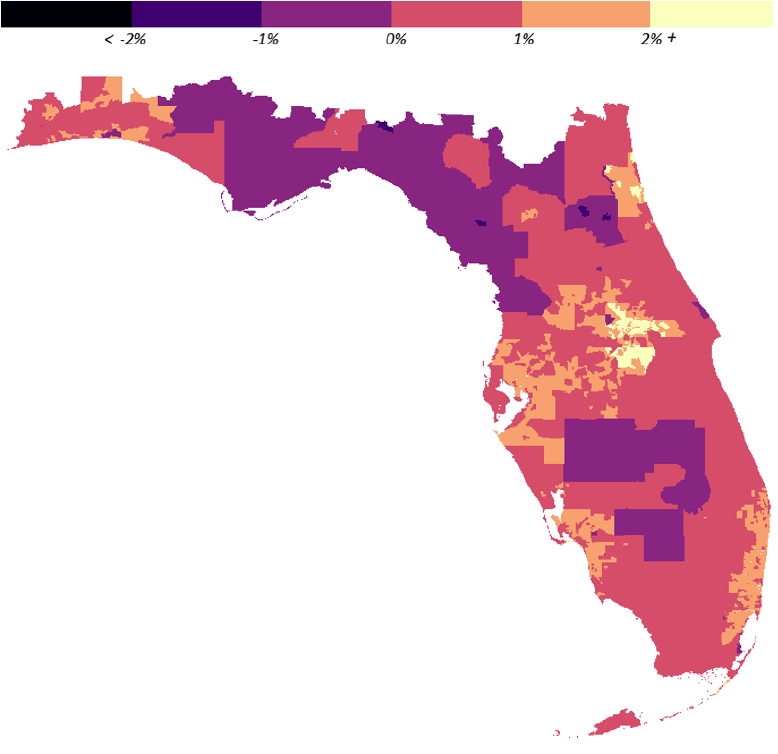
The Florida counties expected to experience the most significant population growth despite flood risks include Osceola, St. Johns, Orange, Sumter, Walton, and Lee.
These areas benefit from factors such as proximity to job markets, affordable housing, quality of life, and investments in infrastructure and technology. Osceola and Orange counties, for example, are thriving due to their connection to Orlando’s strong economy and diverse job market, while St. Johns County attracts residents with its excellent schools and climate-resilient suburban communities. This combination of affordability, economic opportunity, and lifestyle appeal ensures that these regions will continue to draw new residents even with heightened flood risks. Florida’s unique blend of risk-taking behavior and affordability-driven migration underscores its status as a state where people are willing to balance hazards with the promise of a better life.
Florida exhibits a negative correlation between investment and population growth. This may be due to clean energy initiatives such as solar and wind farms that are often located in rural areas with ample land rather than in high-growth metro regions. While Florida is also investing in urban resilience and grid modernization to address climate risks, these efforts are often geographically distant from high-growth areas, resulting in the observed negative association.
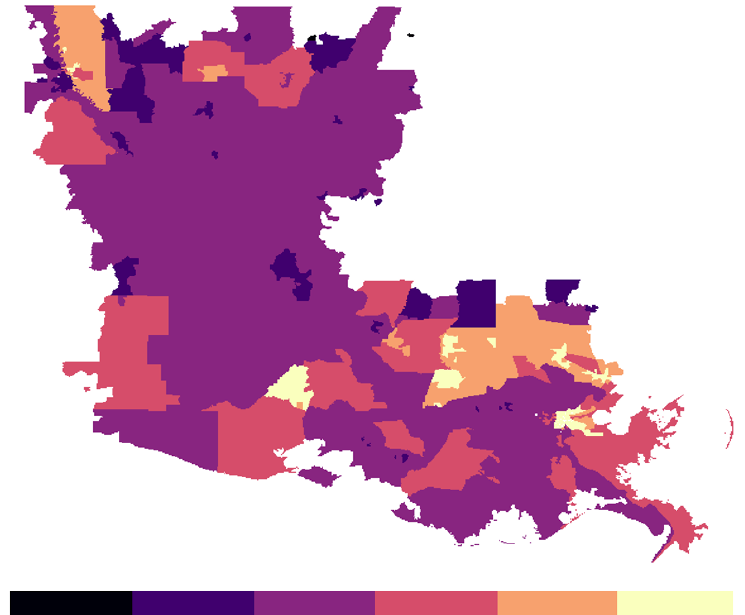
Louisiana exhibits significant flood exposure, with 75% of its census tracts at risk, more than half facing substantial danger. Despite being considered a “doomed” state due to its vulnerability to flooding, people continue to move to high-risk areas within the state. This trend may be attributed to increased mitigation efforts, adaptation measures, and infrastructure investments that make these regions appear safer or more resilient.
To explore this further, we analyzed the White House investment dataset alongside Louisiana’s population growth. The data suggests a possible correlation between corporate investment and population growth, indicating that funds are being directed to areas requiring mitigation efforts. People move to risky zones if they perceive them as safer due to ongoing protective measures.
In terms of affordability, residents seem to be staying in high-risk or high-cost areas. This is evident in the suburban areas around New Orleans and Baton Rouge, specifically parishes such as St. Bernard, Orleans, Ascension, Livingston, and St. Tammany. Factors such as job creation, infrastructure investment, post-Katrina resettlement, affordable housing, improved flood protection through levee upgrades, and other climate resilience projects all play a role in overcoming flood risks to maintain demographic vitality.
Resilience-seeking States
Michigan exhibits contrasting behavior to Florida and Louisiana, with only 39% of census tracts exposed to flood risk. The association between economic resilience and population growth is stronger in safe areas than risky ones, highlighting how people are deciding where to move on the basis of affordability, home values and other economic factors.
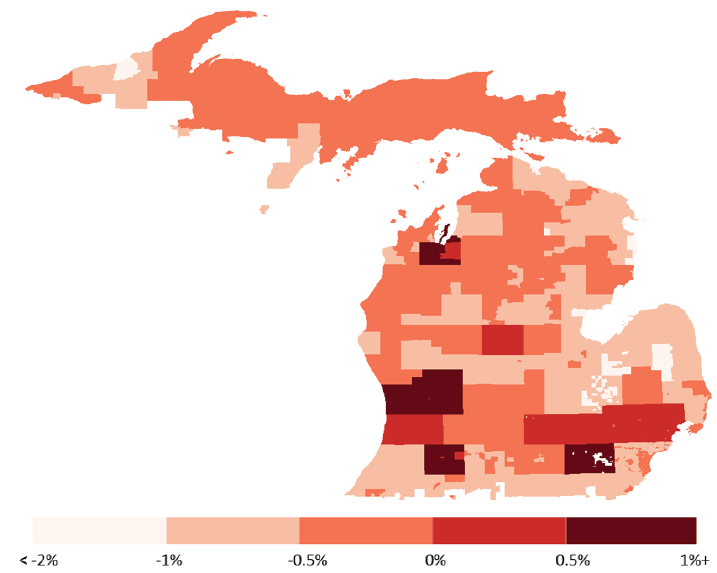
Counties such as Washtenaw, Ottawa, Kent, Kalamazoo, and Grand Traverse are emerging as safe havens for long-term migration due to their low vulnerability to climate risks, strong economic foundations, and access to natural resources. This trend underscores Michigan’s appeal as a state where safety, resilience, and affordability drive migration decisions, offering a stark contrast to Florida’s risk-taking tendencies.
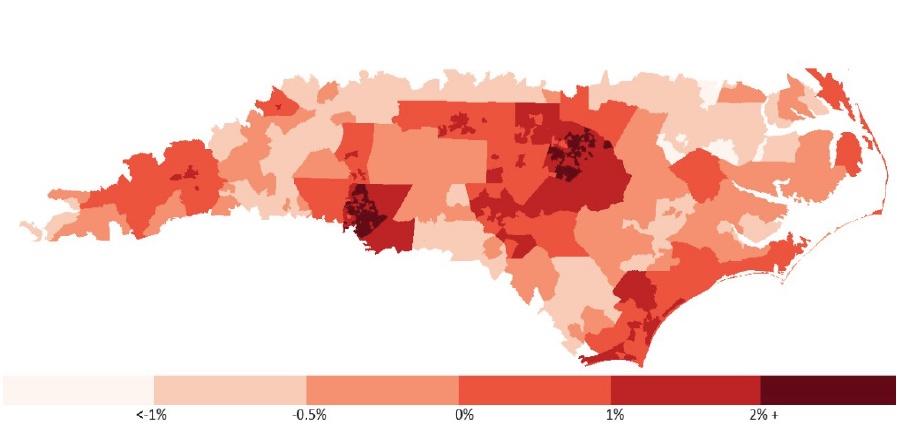
North Carolina faces low to moderate flood exposure, with 29.5% of its census tracts at risk. The state is expected to experience resilience-driven population growth as residents prioritize safety, stability, and quality of life over affordability. A strong association between population growth and resilience is observed in both risky and non-risky areas, reflecting a preference for stability and lifestyle. However, the correlation is stronger in non-risky areas, emphasizing that safety is a key priority alongside quality of life. This trend highlights a shift toward resilience-seeking migration, where secure, sustainable living and enhanced lifestyles drive decisions.
By 2055, Mecklenburg, Wake, Durham, Cabarrus, Union, and Harnett counties are projected to remain among North Carolina’s fastest-growing areas due to their robust economic opportunities, advanced infrastructure, and high quality of life. Mecklenburg (Charlotte) and Wake (Raleigh) will continue to thrive as major economic hubs, drawing businesses and skilled professionals, while Durham’s Research Triangle and leading universities will sustain innovation and talent development. Surrounding counties like Cabarrus, Union, and Harnett will further benefit from their proximity to these urban centers, offering affordable housing and appealing suburban lifestyles. Ongoing investments in infrastructure and flood mitigation will further enhance resilience, attracting residents seeking safety and stability. Coupled with cultural amenities and a favorable climate, these factors will solidify their status as top destinations for growth in the coming decades.
The Path Forward
Our findings have implications for key stakeholders:
For Real Estate Developers & Investors:
- Focus on areas with lower climate risk, higher population growth, and strong investment potential
- Expand housing supply in climate-safe regions to maintain affordability
- Consider adaptation investments in high-growth, moderate-risk areas
For Government & Policymakers:
- Align infrastructure investments with climate resilience and projected population growth
- Support housing development in climate haven regions
- Invest in adaptation measures for economically important but climate-vulnerable areas
For Families & Individuals:
- Consider long-term climate risk alongside traditional factors like jobs and schools
- Look for areas investing in resilience and adaptation
- Balance immediate needs with future climate projections
The Conclusion: Aligning Migration and Resilience
Climate migration is inevitable, and the only solution is to better identify safe locations and buttress the resilience of locations with growing populations. Real estate investors and developers should strengthen their focus on areas with lower climate risks, higher population growth, and greater investment potential, expanding supply in such locations to ensure affordability. Both the government and private sector should consider aligning investment with climate resilience and population growth to reinforce a positive cycle. This appears to be the case in Michigan and North Carolina.
This research note is an excerpt of our investigation covering all census tracts nationwide. We look forward to working more closely with our clients and partners across the public and private sectors to support their efforts to invest in greater resilience.
Learn More
Our population migration forecasts are now available as part of our Location Dynamism Signals product, which scores locations across key dimensions of market performance to identify top-performing geographies of the future. One such dimension is our “Projected Population Change by 2050” metric, which captures the effects of climate migration. This metric is also available on a standalone basis through our Global Data Marketplace.
To learn more about our data, products and services, contact us at info@alphageo.ai.